
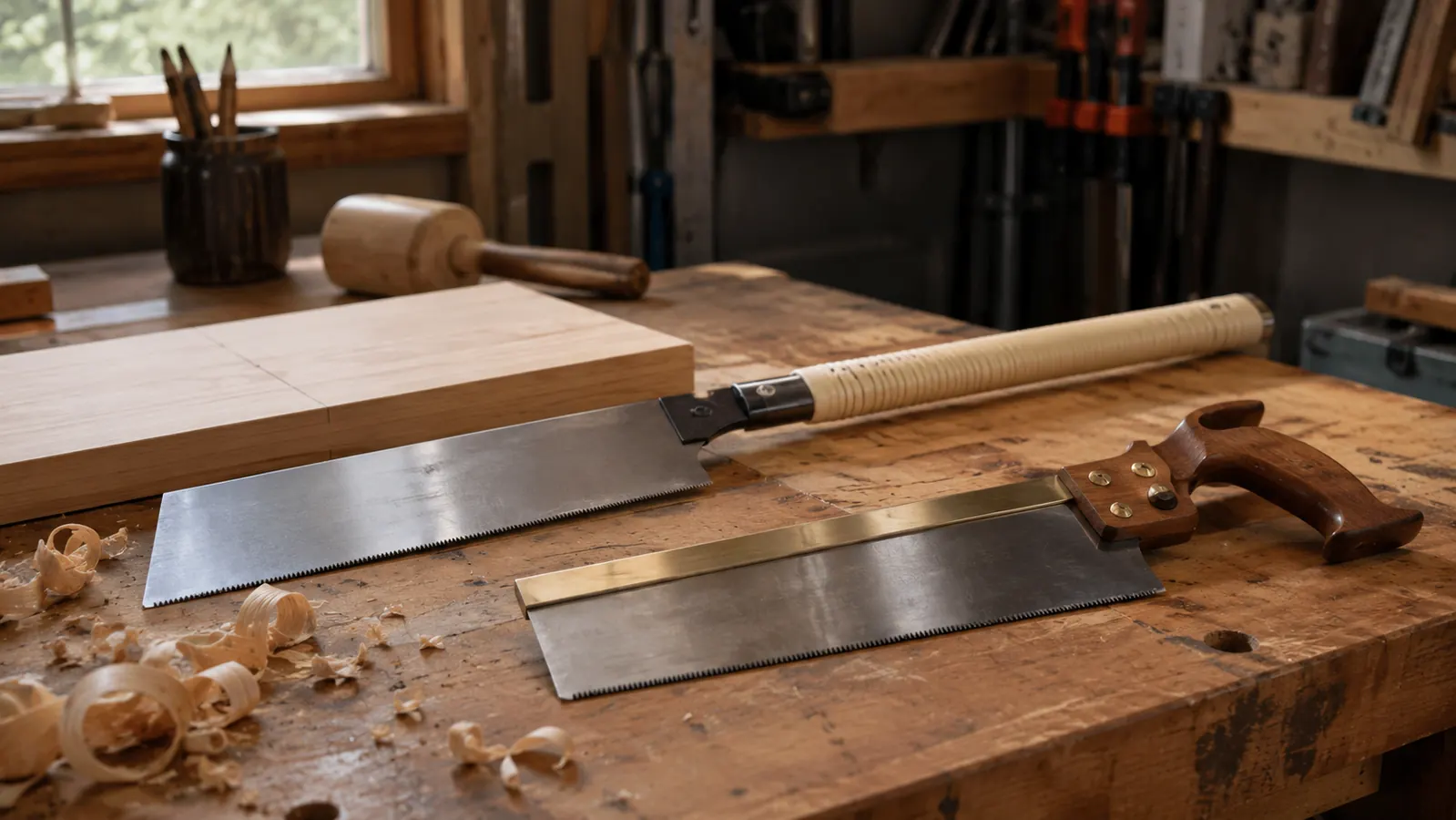
Two saws, two different ideas about how a cut should begin. The SUIZAN Ryoba is a Japanese double-edge pull saw: rip teeth at 9 teeth per inch along one edge, fine crosscut teeth at 15 along the other, a 9.5 inch blade, and a kerf of 0.03 in (0.8 mm), which is roughly the width of a heavy pencil line. The western backsaw is the tool most of us were taught on: a stiff spine along the top of the plate, a push stroke, teeth filed for crosscutting, and a bench hook or a miter box to keep it square. I have kept both within arm's reach of the bench for the better part of a year, and I am not giving up either one.
So here is the short answer before the long one. If the cut has to land dead square in a joint, a tenon shoulder, a miter, the cheek of a small box, I reach for the backsaw. It rides in the bench hook, the spine keeps the plate from buckling, and the saw tells me when I am off square. For nearly everything else, crosscutting a board to length, sizing stock, trimming a fitted piece, cutting thin stock, working where there is no room to clamp a bench hook, the ryoba is faster, cleaner at the line and easier to steer. Starting from nothing, buy the ryoba first. Keep the backsaw for the joints.
| SUIZAN Ryoba 9.5 in | Western backsaw | |
|---|---|---|
| How the cut starts | Pull stroke draws the teeth into the line, so the blade starts where it is set | Push stroke needs a thumb guide or a started kerf, and can skip off a corner |
| Kerf | 0.03 in (0.8 mm), so little wood is removed and the saw runs free in hardwood | Set teeth and a heavier plate remove more wood per stroke |
| Depth of cut | No spine, so the blade follows a cut deeper than the blade is long | The spine bottoms out on the work and limits how deep the saw can go |
| Square in a bench hook | Thin plate will flex if the stroke wanders, and a shoulder shows it | Spine holds the plate straight, so shoulders and miters come out square |
| Familiarity | Pull stroke and a wrapped handle take a few afternoons to learn | Push stroke and closed grip that most of us grew up with |
| Sharpening | Blade is held by one screw and comes off for a replacement blade (sold separately) | Can be filed by hand, crosscut or rip, and filed again years later |
| Trimming and flush cuts | Flexible plate reaches spots a backsaw cannot, and the pull stroke does not lift veneer | Spine fouls on the work in tight places |
| Thin stock and small parts | 0.02 in (0.5 mm) plate and 15 TPI crosscut edge leave a clean shoulder | Heavier plate can tear a thin, short piece |
| Weight in the hand | 0.2 kg, and the pull stroke means you are not shoving the weight through the wood | Heavier, and you supply the push on every stroke |
| Best for | Crosscutting to a line, deep cuts, trimming, first saw on the bench | Tenon shoulders, miters, dovetail waste cut in a bench hook |
One note on reading that table. The winner column is decided per row, not per saw. Nobody takes nine rows out of nine, and a comparison that claims otherwise is a sales page wearing a review's clothes. Where the ryoba loses here it loses on the cuts that decide whether a joint closes up tight, and where the backsaw loses it loses on almost every other cut you make in an afternoon.
Where the SUIZAN Ryoba Wins
It starts the cut exactly where I put it. That sounds like a small thing until you have watched a backsaw skip off the corner of a walnut board and take a chip out of a face you had already planed flat. A pull saw has nothing pushing behind the teeth at the start. The blade sits on the line, the first stroke draws the teeth in, and the kerf opens right where it was set. The 9 TPI rip edge does the fast work along the grain and the 15 TPI crosscut edge leaves a surface I can shoot with a plane in two passes.
The second advantage is the kerf. At 0.03 in (0.8 mm) the saw removes very little wood, and the 0.02 in (0.5 mm) plate follows that channel without dragging. In dry white oak, that is the difference between a cut you work through and a cut you fight through. There is no spine to bottom out either, so a 9.5 inch blade keeps going into a board far thicker than the saw is long, and with no spine it reaches into places a backsaw simply cannot go. The last time that mattered was a repair on a neighbor's old house, trimming the end of a quarter inch piece of pine that had to slip behind a door casing with the wall still standing. There was no room to clamp a bench hook, no room to swing a backed saw, and about three inches of clearance. The ryoba went in flat, cut on the pull, and was done in two strokes.
One screw holds the blade, so when the teeth finally go, the blade comes off and a replacement goes on. The saw measures 23.2 in long overall, tip to the end of the handle, which is short enough to hang on a nail above the bench and long enough to crosscut a twelve inch board without repositioning.
Where the Western Backsaw Wins
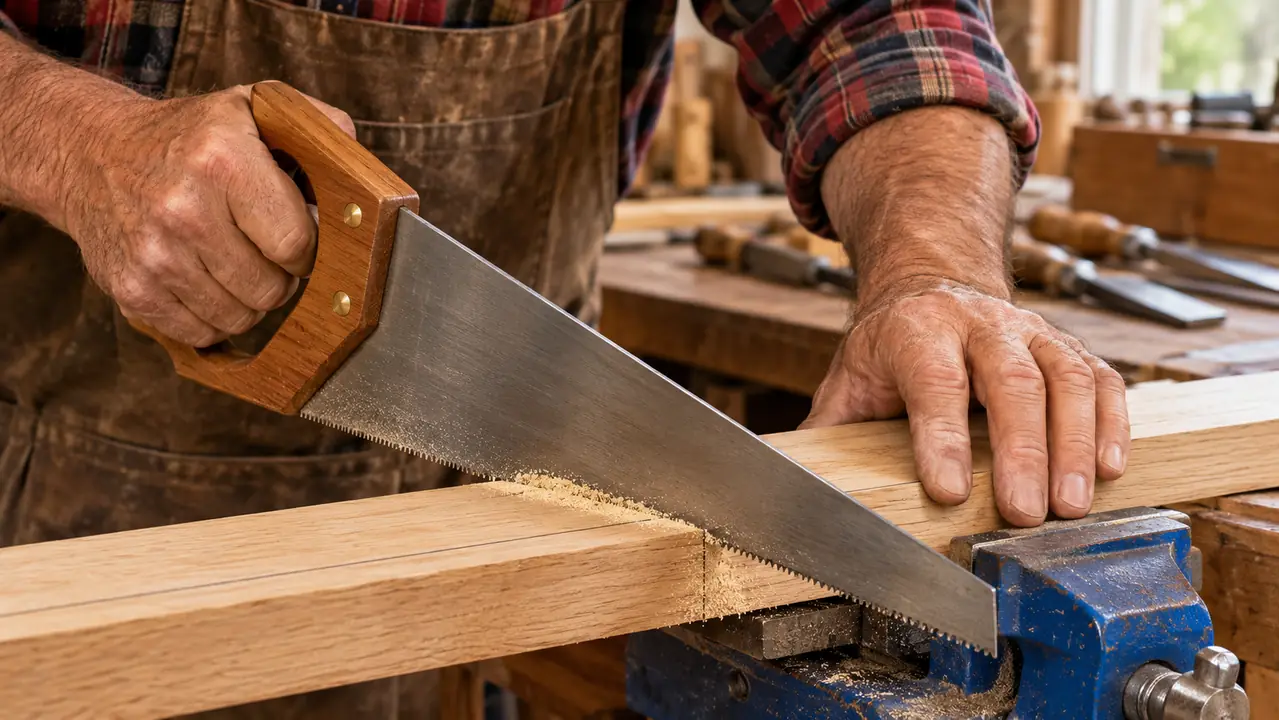
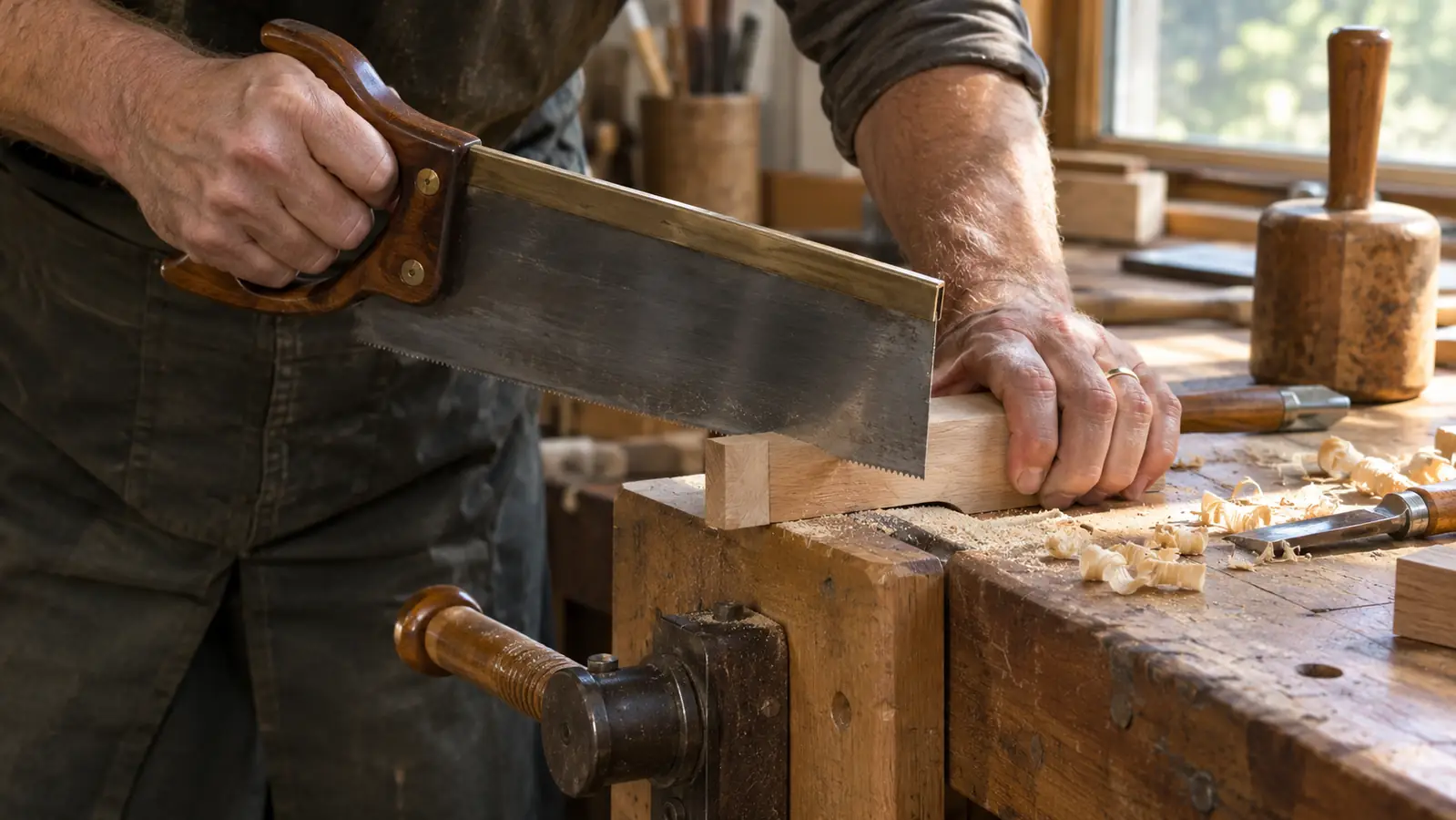
Square. That is the whole argument, and it is a good one. The spine along the top of the plate keeps the blade from buckling sideways, and when the saw sits in a bench hook with the work clamped against the hook, the back rides against the plate and the cut stays true. Tenon shoulders, mitered trim, the ends of a small box: those cuts have to be square in two directions at once, and the backsaw does it with less fuss than any pull saw I have used. The ryoba plate will flex if my stroke wanders, and in a shoulder cut a flexing plate means a shoulder that needs paring back to the line.
The mitered returns on a piece of window casing I fitted for a neighbor last spring are the example I keep coming back to. Four pieces, each cut at 45 degrees, each one having to meet the next with no gap at the outside corner and no shadow at the inside. I cut all four in the miter box with the backsaw, checked each against a square, and they closed up on the first try. I would not attempt that with the ryoba, and I do not say that as a criticism of the saw.
Then there is sharpening. A backsaw can be filed by hand, crosscut or rip, and filed again a decade later, which is not a small thing for a tool you mean to leave to somebody. The SUIZAN blade is not something I would try to file at the bench. The design is to loosen the single screw and fit a new blade, sold separately, and that is what I will do when the teeth dull. There is also the plain matter of habit. I learned to saw pushing, with my index finger along the plate, and forty years of that does not disappear because a saw is well made. My first week with a pull saw I cut slower than I did with the backsaw, because every stroke felt backwards.
The ryoba starts the cut exactly where I set it. The backsaw finishes it exactly where I need it, square, in the hook, without an argument.
A blade thin enough to start the cut where you set it
Rip teeth at 9 TPI on one edge, crosscut teeth at 15 on the other, a 0.03 in kerf, and a blade that comes off with one screw when the teeth wear. This is the saw that leaves my bench most often.
Amazon Check Today's Price on Amazon →The Two Cuts, and Why They Behave Differently
A western saw cuts on the push. Pushing a thin plate through wood puts it in compression, and a plate in compression wants to buckle, which is the entire reason every backsaw carries a spine along its top. The spine exists to do one job: keep the plate straight while you shove it. A Japanese saw turns that around. It cuts on the pull, the stroke puts the plate in tension, and a plate in tension pulls itself straight. That is why the SUIZAN blade can be 0.02 in (0.5 mm) thick and carry no spine at all.
A thin plate means a narrow kerf, and a narrow kerf means less wood to lift out of the cut. At 0.03 in (0.8 mm) the saw is opening a channel about the width of a heavy pencil line. A typical western backsaw, with its teeth set wider than the plate, opens a noticeably wider channel for the same board. Less wood, less friction, less heat, and a straighter cut in dry hardwood. It also changes how you steer. With the backsaw I lean a shoulder into the stroke. With the ryoba I steer with the handle and a fingertip, because the blade is doing the work and I am only deciding where it goes.
The trade is stiffness, and it is a real trade, not a marketing footnote. A pull saw stays straight only if your stroke is straight. Pull true and the blade follows true. Pull off line and the blade follows you off line, quietly, without chattering and warning you about it the way a buckling backsaw will. The spine on a backsaw does not care how tired your arm is at four in the afternoon. That single difference explains every row in the table above.
What I Liked
- 0.03 in (0.8 mm) kerf removes very little wood, so the saw runs easier in dry hardwood
- Two edges on one saw: 9 TPI rip teeth and 15 TPI crosscut teeth
- Pull stroke starts the cut where the blade is set, with no skipping off the corner
- 0.02 in (0.5 mm) plate and no spine, so it follows a cut deeper than the blade is long
- Blade comes off with a single screw for a replacement
- 0.2 kg, and the pull stroke means you are not pushing the weight
Where It Falls Short
- Thin plate flexes if the stroke wanders, which shows up first in shoulder cuts
- No spine, so it does not ride a bench hook the way a backsaw does
- Blade is replaced rather than filed, and the replacement blade is sold separately
- The pull stroke feels backwards for a week if you learned on western saws
What Six Months of Switching Taught Me
The first thing I had to unlearn was bearing down. With a backsaw you can lean on the stroke a little and the spine forgives you. Lean on a pull saw and the plate bows, the cut wanders, and you blame the saw. I ruined the first shoulder I attempted that way, on a small white oak bench for a neighbor, and I spent twenty minutes paring back to a line I should have hit in one pass. That afternoon was a cold one, the wood stove going and the garage door down, and I was in a hurry to get the bench out of the shop before dark. I had a two inch leg blank up in the vise, the line struck with a marking knife, and I leaned into the first shoulder the way I had leaned into ten thousand before it. The plate bowed, the far corner came out of square, and I lost the afternoon. The fix was not technique so much as trust. Let the teeth do the work and steer with the handle.
The second thing I learned is that these two are not competing for the same cut, no matter how the catalogs frame it. Both stay on the bench now. The ryoba does the crosscutting, the sizing and the trimming, and the backsaw does the joinery. What surprised me is how often the ryoba comes off the wall first. Crosscutting a board to length used to be a two-minute job with the backsaw and the bench hook. With the ryoba it is nearer a minute and the line is cleaner, so there is less planing afterward. Last month I broke down six boards of four-quarter cherry for a small chest, every one of them crosscut to length on the ryoba, and I doubt I spent eight minutes at it. The same six boards with the backsaw and the hook would have taken me twice that, and left me a stack of ends to shoot square afterward.
Who Should Buy Which
Buy the SUIZAN Ryoba if you are building a hand-tool kit and can only buy one saw right now. It covers more jobs: crosscutting to a line, sizing stock, trimming a fitted piece, cutting thin stock, and working where there is no room to clamp a bench hook. If you cut joints in a hook every day and you already own a backsaw that fits your hand, you own the better tool for that one job and the ryoba will not replace it.
Keep the backsaw, or buy one, if your work is joinery first and stock preparation is something you do once in a while. Tenon shoulders, miters, dovetail waste: the spine earns its keep there, and a saw you can file yourself will outlast both of us. If you are fitting out a bench from scratch and want the saw you will not have to think about, the ryoba is the one that stays out on the bench instead of going back on the wall.
There is a third case worth naming. If you are forty years into pushing a western saw, do not expect the pull stroke to feel natural by the end of the first afternoon. Give it a week of small jobs before you decide anything. Mine sat on the wall for a month before it earned a place at the front of the bench, and what changed my mind was not the surface finish. It was that I stopped dreading the crosscuts, and a tool that takes the dread out of the ordinary work is worth the space it occupies.
The saw I reach for before the backsaw, nine times out of ten
A 9.5 inch blade with rip teeth on one edge and crosscut teeth on the other, a 0.03 in kerf, and a blade that swaps with one screw. Start here, then add the backsaw when the joinery calls for a spine.
Amazon Check Today's Price on Amazon →