
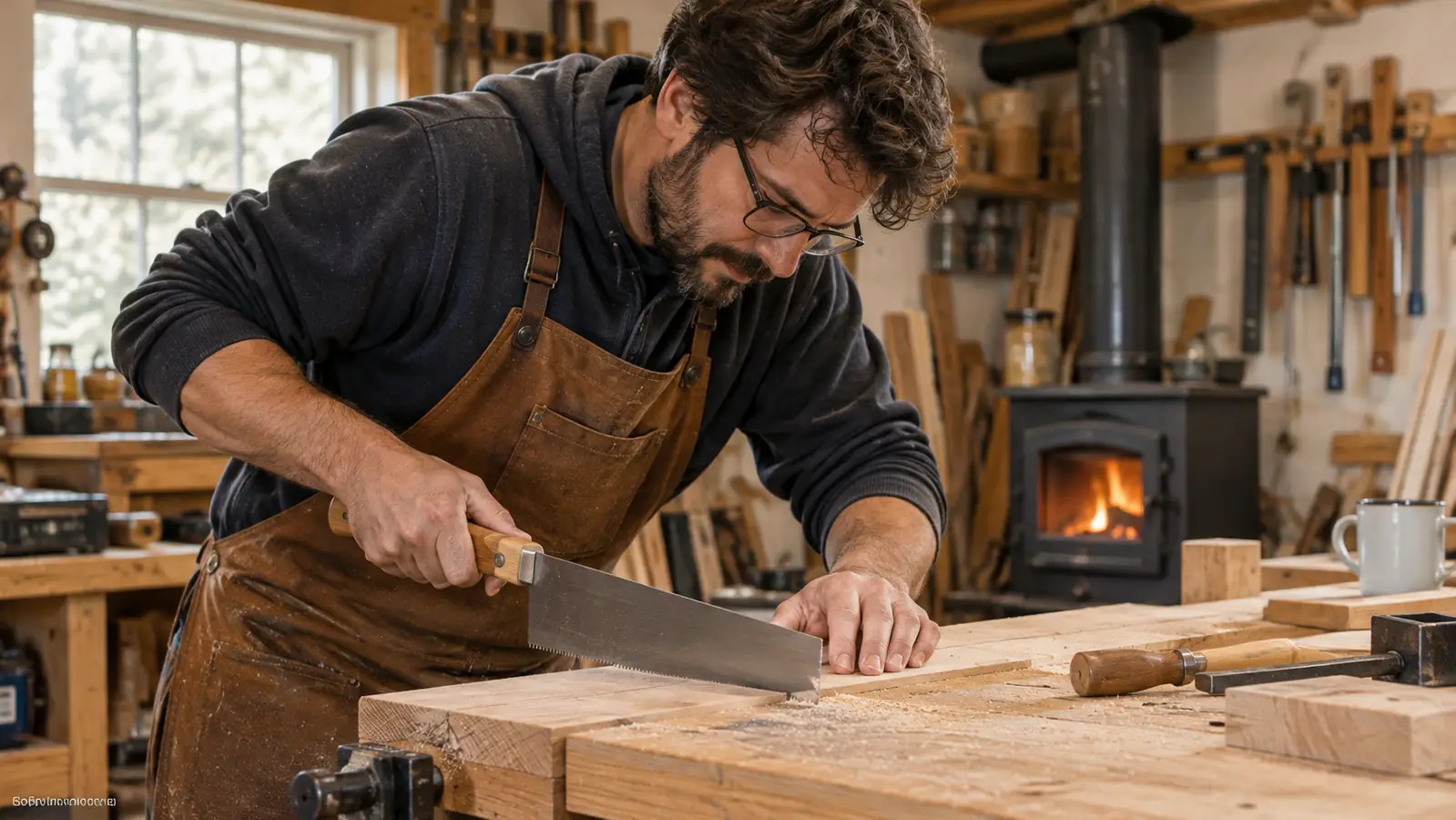
A ryoba is a Japanese hand saw with teeth on both edges of a single blade. The coarse edge rips, the fine edge crosscuts, and both of them cut on the pull stroke. That last part is what throws people who learned on a western saw. You are not pushing a stiff plate through the wood and hoping it lands where you aimed. You are pulling a thin blade through and steering it with your fingers.
I have had the SUIZAN Ryoba Double Edge Saw, the 9.5 inch one, on the pegboard above my bench for a while now. It is the saw I reach for when a cut has to land on a line and I do not feel like walking over to the table saw. What follows are ten reasons it earns that spot, in the order they actually matter at the bench.
The saw I reach for before I walk to the table saw
A double edge blade, 9.5 inches, with 9 TPI for ripping on one side and 15 TPI for crosscutting on the other. It cuts on the pull, so it starts clean and stays on the line.
Amazon Check Today's Price on Amazon →It cuts on the pull, so the blade goes where you aim it
Here is why the saw behaves the way it does. A western saw needs a thick plate and a folded steel back because you push it, and pushing a thin blade through wood folds it over inside the kerf. A pull saw works in tension instead. Pull the handle and the force runs down the length of the blade and keeps it straight, so the plate can be thin and the cut can be steered with your fingertips rather than your shoulder. My first cuts with a pull saw were straighter than my first year of cuts with a backsaw. That is not a brag, it is the geometry of the thing.
Two tooth counts on one blade, 9 TPI to rip and 15 TPI to crosscut
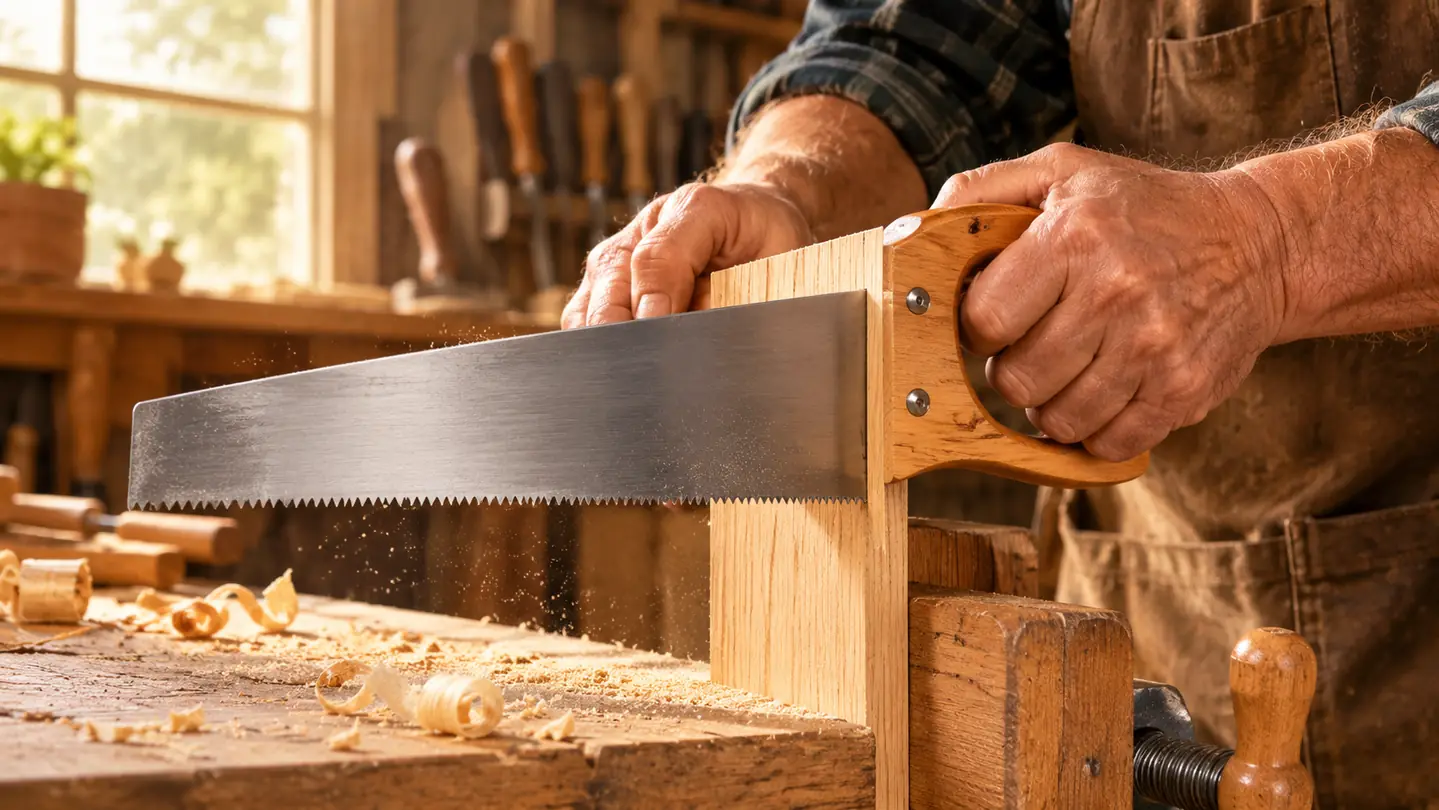
The SUIZAN ryoba carries 9 teeth per inch on the rip edge and 15 on the crosscut edge. Teeth per inch, usually written TPI, is just a count of how fine the tooth line is. More teeth means a slower cut and a cleaner surface. Nine teeth clear waste quickly when you are cutting along the grain. Fifteen teeth leave a cleaner shoulder when you cut across it. I used to keep a rip saw and a crosscut saw within reach of the vise. Now I keep one saw and turn it over. The blade is 9.5 inches, and the saw measures 23.2 inches end to end.
A narrow kerf saves the wood and saves your line
A kerf is the slot the saw makes, and it is wood you never get back. The plate on this saw is 0.02 in (0.5 mm) thick, and the set of the teeth opens a kerf of about 0.03 in (0.8 mm). On a tenon shoulder that difference is the difference between a joint that closes and one you have to shim. It also means most of what comes off the cut is dust rather than chips, which matters when you are trimming a part to a line and do not want to lose the line in the process. Narrow kerf, less waste, fewer surprises at the test fit.
It lies flat for flush cuts, because there is no back to stop it
With teeth on both edges there is no folded steel back along the top, and that is what lets the plate lie flat on the work. I use mine to trim a plug or a dowel down to the surface. Lay the blade flat, pull gently, and the fine teeth work down to the surface without the body of the saw stopping you. The same thin plate follows a tenon cheek all the way to the shoulder. A backsaw cannot do either job, because its back hits the work long before the teeth reach the depth you wanted.
One screw holds the blade, so the handle is not disposable
A single screw holds the blade in the handle. That is the whole fastening. Loosen it, slide the blade out, and the saw packs into a drawer or a toolbox without a foot of steel sticking out of it. It also means the handle keeps working for years. When the teeth wear down, or when you kink a blade by twisting it sideways in a cut, you fit a SUIZAN 9.5 in replacement blade, sold separately, and the saw goes back on the pegboard. I have kinked exactly one blade in all this time, and it was my own fault for prying with it.
At 0.2 kg you can hold it out and still steer it
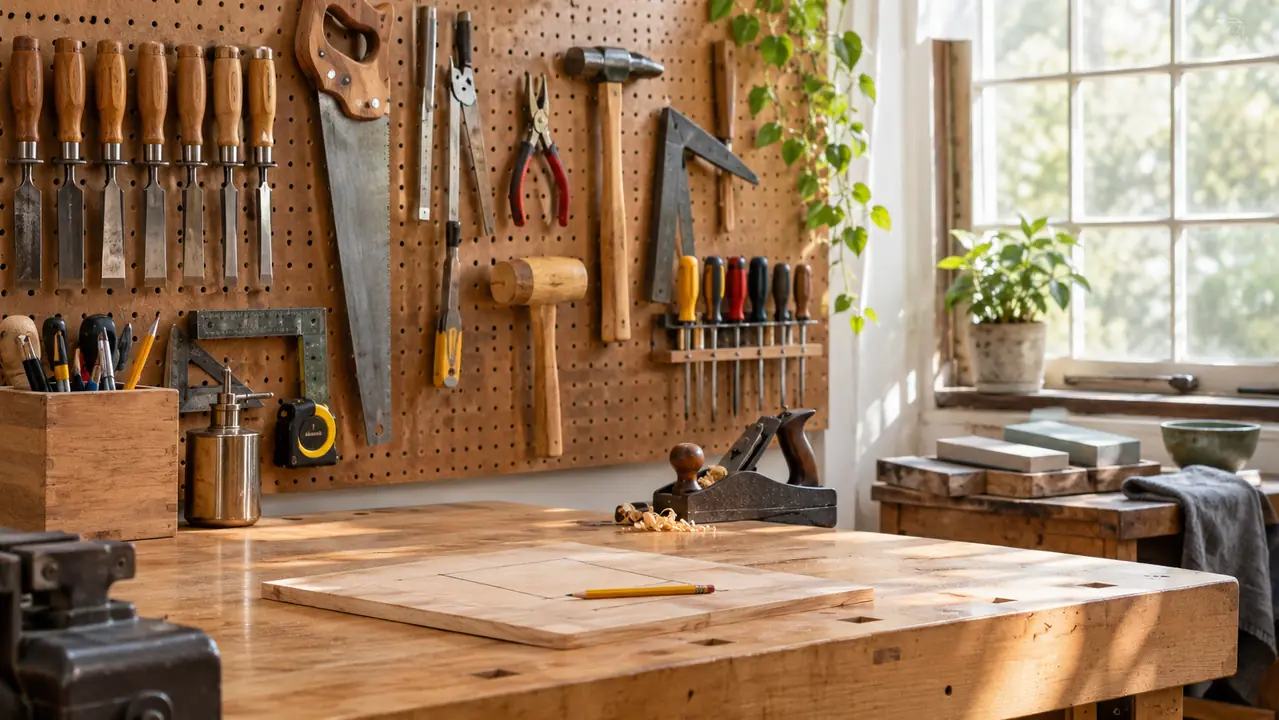
The whole saw is listed at 0.2 kg. That is light enough to hold out at arm's length and still control, which is what you are doing on a longer crosscut, holding the saw up on the line rather than resting it on the work. Weight is not always the enemy. A heavy saw tracks well in thick stock and does some of the work for you. But for the small parts most of us cut at a bench, boxes, drawer sides, trim, a light saw tires your wrist less and lets you feel the teeth instead of fighting the mass.
It reaches depths a backsaw's spine will not allow
A backsaw's back is a steel spine folded over the top edge, and it limits how deep you can cut. Once the spine meets the work, that is the end of the cut. The ryoba has no spine, so nothing stops the blade short of the depth of the plate itself. I use that for trimming tenon cheeks on a wide rail where a backsaw would have run out of room, and for cleaning out the bottom of a shallow stopped groove. It is not a reason to retire the backsaw. It is the reason the ryoba stays out on the bench instead of in the till.
The fine edge starts a cut on a corner with almost no pressure
Starting a cut is where most people give up on pull saws. You have to start on the pull, and the first instinct of anyone raised on a western saw is to push. I did it for a solid month and left a row of ragged starts in a piece of scrap pine. The fix is simple. Set the 15 TPI edge on the far corner, put your thumb against the plate to steady it, and draw the saw back with almost no downward pressure. Two or three light pulls cut a groove, the saw sits in it, and the rest of the cut mostly takes care of itself.
It teaches you to saw by feel, and that carries to every other saw
After a few months with a thin pull saw you start cutting by feel instead of by force. You hear the teeth loading up. You feel the blade drift off line while the cut is still shallow enough to correct. That carries straight over to the backsaws and the tenon saw. I cut better with a backsaw now than I did ten years ago, and it is because this saw taught me to let the teeth do the work and keep my shoulder out of it. A power saw will not teach you that, because it never asks you to listen.
It ships with a blade guard, which is a small thing that matters
The saw arrives with its blade and a blade guard, which sounds like nothing until you have had an unguarded saw in a drawer eat through the edge of a chisel roll. The guard goes on and off in a second, so the saw can ride in a toolbox without you worrying about the teeth. SUIZAN backs it with a 30 day warranty. A pull saw is a low risk thing to try, and if you already cut joinery by hand, you probably needed one on the wall years ago.
Pull the handle and the force runs the length of the blade and keeps it straight, so the plate can be thin and the cut can be steered with your fingertips.
What I'd Skip
I would skip this saw for two jobs. The first is demolition. There is a lot of old house in my past, and I have pulled nails out of studs with every tool you can name. A pull saw's teeth are thin and hard and they do not enjoy meeting a nail. Use a wrecking bar and a rough panel saw for that and keep this one for wood. The second is sheet goods. If most of your cutting is plywood and MDF broken down to size, a circular saw is the right tool and no hand saw will keep up with it.
One more thing I would tell you straight. If dovetails are the goal, a ryoba will cut them, but its blade is thin and flexible, and a fine backsaw with a stiff spine holds a line at the baseline better. The ryoba is the saw to start with, not the only saw you will ever want. Buy it, use it for a season, and then decide what else your work is asking for.
One handle, two tooth counts, and a blade you can replace with one screw
If you cut joinery by hand and you do not own a pull saw yet, this is the one to start with. The guard keeps the teeth intact in a drawer, and the blade comes out when it wears.
Amazon Check Today's Price on Amazon →