
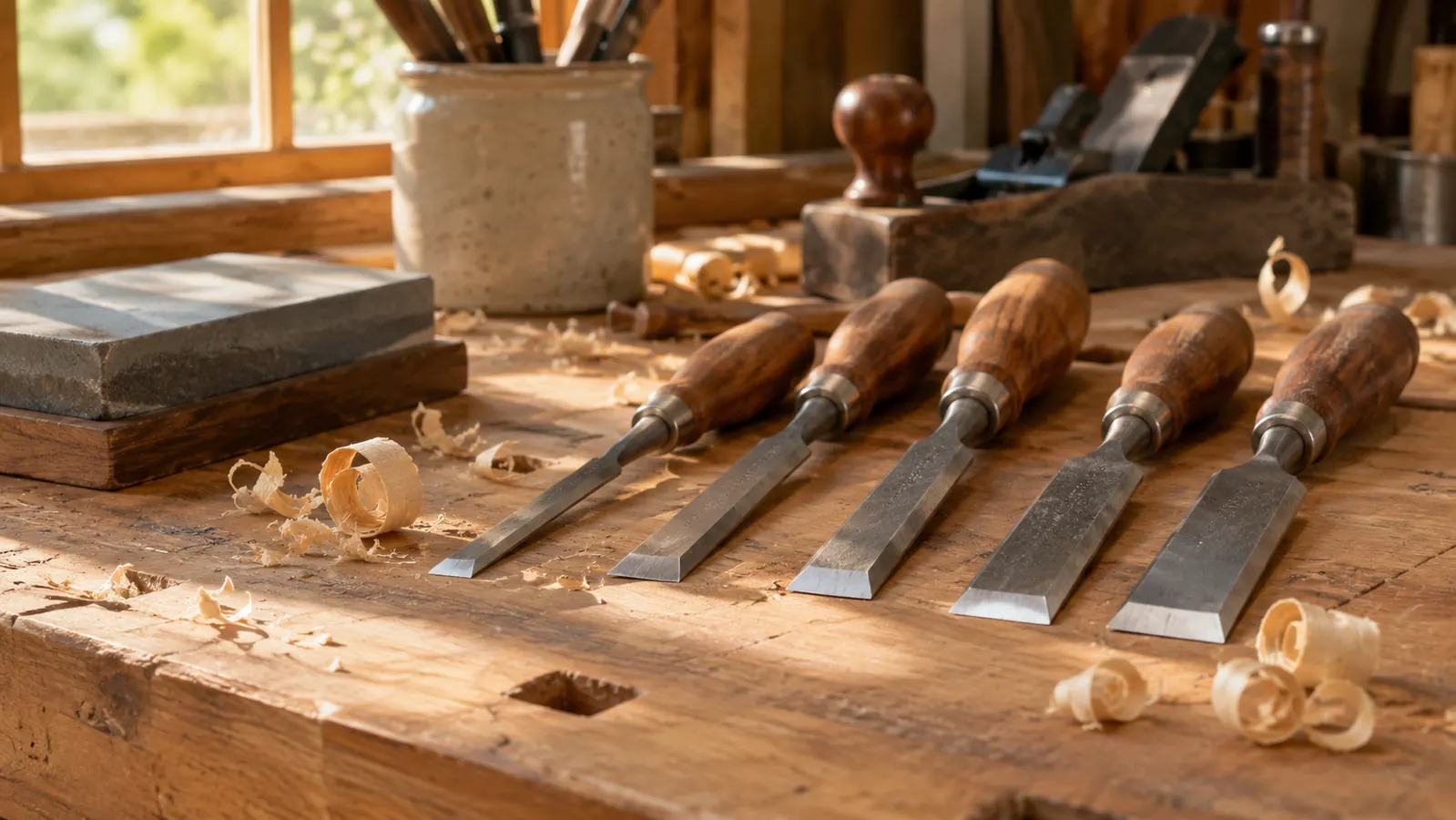
Six months ago I cleared a space on the maple bench for a set of Narex chisels and promised myself I would not baby them. I have repaired two old houses and built more small boxes than I can count, and I have owned chisels that cost more and chisels that cost less. What I wanted to know was simple: would a six piece bevel edge set hold a working edge through real paring, chopping and cleanup, or would I spend my evenings at the sharpening station?
The short answer is that the Narex set has stayed on the bench. Not because it is fancy. Because the edges are straightforward to bring up, the sizes cover the work I actually do, and the handles feel at home in my hand after a couple of hours. I have used them on white pine, hard maple, white oak and one piece of butternut that a neighbor brought over. They have done everything from cutting hinge mortises in an old door to paring the shoulders on a small walnut box.
The Quick Verdict
A practical six piece set for hand-tool work, with edges that respond well to a stone and a size range that covers most bench tasks.
Amazon Check Today's Price →Six sizes that earn their space on the bench
The Narex set is not a collector's item. It is a working set of bevel edge chisels in 6, 10, 12, 16, 20 and 26 mm, with blades hardened to Rc 59 and a 25 degree bevel from the factory. If you want to spend your time cutting joints instead of rehabbing tools, start here.
Amazon Check Today's Price on Amazon →How I've Used It
I keep the set in the wooden presentation box on a shelf under the bench. That box is not a display piece in my shop. It is a way to keep the edges from knocking against each other when I move things around. The 6 mm and 10 mm chisels live on the bench most days. The 16 mm and 20 mm come out for hinge mortises, cleaning up dados and paring wide shoulders. The 26 mm is the one I reach for when I need to remove a lot of waste in a hurry, or when I am fitting a patch into an old piece of trim and need a broad, flat cut.
I have used them with a mallet and by hand. For chopping, I keep a light touch. These are bevel edge chisels, not heavy mortise chisels, and I do not treat them like a wrecking bar. The 25 degree bevel is a good compromise for paring and light chopping. When I need to chop a deep mortise in hard maple, I switch to a heavier tool. That is not a knock on the Narex set. It is knowing what the tool is for.
One morning I dropped the 6 mm chisel on the concrete floor while I was cleaning up. It landed on a corner and took a small nick. I spent about ten minutes on a diamond stone and a fine ceramic stone, and it came back. The steel is hard enough to hold an edge but not so hard that it feels brittle under the stone. I have had chisels that felt glassy and chipped if I looked at them wrong. These have not done that.
Out of the box, the edges were ground at 25 degrees but they were not honed to a fine edge. I expected that. I spent an evening flattening the backs and working through a diamond stone, a fine ceramic stone and a strop. The 6 mm and 10 mm were the quickest. The wider chisels took a little longer. If you are not willing to do that setup work, you will not get the best from any new chisel, and that includes this set.

What the Six Sizes Actually Cover
The set runs from 6 mm to 26 mm in six steps: 6, 10, 12, 16, 20 and 26 mm. That is a sensible spread for furniture and repair work. The 6 mm is small enough to clean out the corners of a dovetail or a hinge gain. The 10 mm and 12 mm are the generalists. The 16 mm and 20 mm handle the wider cuts, and the 26 mm is the one that saves time when you are paring a long shoulder or fitting a patch.
I have seen sets that jump from 12 mm to 25 mm and leave a gap that matters. This one does not. The 16 mm and 20 mm are close enough that you can pick the one that fits the cut, not the one that is closest. For a hobby shop or a small professional bench, that is a useful range. For heavy timber work, you will want a bigger chisel. For most of what comes through my shop, these six sizes are enough.
The 6 mm earns its keep in the corners. I use it to clean the inside of a dovetail socket and to touch up the corners of a hinge gain. The 10 mm is the one I pick up without thinking. It is wide enough to pare a shoulder and narrow enough to get into a narrow mortise. The 12 mm and 16 mm are the ones I use for general cleanup. The 20 mm and 26 mm are for wider work, and the 26 mm is handy when I need to remove a lot of waste without switching to a plane.
Steel, Bevel, and What Rc 59 Means at the Bench
The blades are chrome-manganese steel, hardened to Rc 59. That number is a hardness reading on the Rockwell C scale. A higher number means the steel resists scratching and wear. A lower number means it sharpens faster but dulls sooner. Rc 59 is a practical middle ground for a bench chisel. It is hard enough to hold an edge in oak, and it is not so hard that it takes forever to restore a nick.
The factory bevel is 25 degrees. That is a common angle for bevel edge chisels. A lower angle cuts more easily but leaves a weaker edge. A higher angle lasts longer but feels less keen. For general bench work, 25 degrees is where I want to start. If I am working in a soft wood and doing a lot of paring, I might hone a slightly lower micro bevel. If I am chopping in hard maple, I might raise it a touch. The point is that the factory gave me a sensible starting point, not an angle I had to fix.
The backs of the chisels were flat enough to work with. I did not have to spend hours flattening them on a granite plate. I did spend some time on each one, because I flatten every new chisel. The 6 mm and 10 mm took the least work. The wider ones took a little more. That is normal. If you expect a factory edge to be ready for fine paring, you will be disappointed. If you expect to do a reasonable amount of setup, you will be fine.
Chrome-manganese steel is not a fancy powder steel, and I am glad of that. It sharpens on the stones I already own. It does not need a special diamond paste or a lot of fuss. I can touch up an edge in a few minutes and get back to work. For a hand-tool shop, that matters more than a steel that holds an edge for a week but takes an hour to sharpen.
Sharpening and Setup: Where the Set Earns Its Keep
I sharpen on a diamond stone, a fine ceramic stone and a leather strop. The Narex chisels fit that routine. I do not use a honing guide for everything, but I do use one for the first sharpening, because it helps me keep the bevel consistent. After that, I hone by hand. The 25 degree bevel is easy to find on the stone, and the edge comes back quickly.
One thing I like is that the handles are stained European beech. Beech is a dense, close-grained wood. It does not feel slippery in my hand, even when the shop is cold and my palms are dry. I have not had a handle work loose. I have not had one split. I have not babied them. They have been dropped, wiped with a rag and left on the bench overnight. That is not a torture test. It is just normal use.
The set weighs 1.6 pounds. That is light enough to move around the shop and heavy enough that the chisels feel solid in the hand. The wooden presentation box measures 6.37 inches long by 13.5 inches wide according to the listing. I keep it on a shelf and take the chisels out as I need them. If you are short on wall space, that box is a simple way to store them.
I do not use a grinder on these chisels. I know some woodworkers do, but I have seen too many edges overheated that way. A diamond stone and a ceramic stone are enough. If I have a nick, I work it out on the coarse diamond stone and then refine the edge. It takes a little time, but it keeps the temper where it belongs. The steel has responded well to that approach.

How They Hold Up Over Months
After six months, the edges are still in good shape. I have not had to regrind any of them. I have honed them regularly, and I have touched up the 6 mm and 10 mm more often because they do the fine work. The 26 mm has seen less use, but it has done its share of paring and cleanup. The beech handles have a few marks. That is normal. A working chisel is going to pick up marks.
I did have one surprise. The 12 mm chisel developed a small burr on the back edge after I used it to clean out a mortise with a mallet. I caught it before it scored the work. I stoned the back and it was fine. That kind of thing happens when you are learning how much force a bevel edge chisel will take. It was my mistake, not a defect in the steel.
The set has not replaced my heavier mortise chisels, and it has not replaced the one old chisel I keep for opening paint cans. It has become the set I reach for first for joinery. That is the highest compliment I can give a tool. It is not the only set I own. It is the one that stays out.
I wipe the blades with a rag and a little oil after a session in oak or any wood that has been sitting in a damp barn. I have not seen rust on the blades. I have not seen a handle crack. The wooden box has picked up a few dings, but it still does its job. If you keep your shop dry and you wipe your tools down, these chisels will hold up.
What I Liked
- Six useful sizes from 6 mm to 26 mm, with no awkward gap in the middle
- Blades are hardened to Rc 59 and hold an edge through normal bench work
- 25 degree factory bevel is a sensible starting point for paring and light chopping
- Stained European beech handles feel secure in the hand
- Wooden presentation box keeps the edges from knocking together
Where It Falls Short
- You will still need to flatten the backs and hone the edges before fine work
- Not a heavy mortise chisel, so deep chopping in hard wood needs a different tool
- The wooden box takes up shelf space if you prefer a wall rack
After six months of paring, chopping and cleanup, the Narex set is still the first set I reach for on joinery.
Who This Is For
This set is for the hand-tool woodworker who wants a working range of bevel edge chisels without turning sharpening into a hobby of its own. It suits a hobbyist building furniture, a returning woodworker setting up a first bench, or a small shop that needs a reliable second set. If you already own a full set of premium chisels, you probably do not need this one. If you are buying your first real set and you want sizes that cover dovetails, hinge gains and general cleanup, the Narex set is a sensible place to start.
Who Should Skip It
Skip it if you need a heavy mortise chisel for timber framing or deep chopping in hard wood. Skip it if you want a tool that is ready to pare end grain straight out of the box with no setup. Skip it if you are a collector who wants a showpiece. This is a working set, and it looks like one after a few months. That is not a flaw. It is just what it is.
A working set, not a display set
If you want six bevel edge chisels that cover the sizes most bench work asks for, and you are willing to spend a little time on the stones, the Narex set is worth a look. Check the current price and the full listing on Amazon.
Amazon Check Today's Price on Amazon →