

I keep both sets within arm's reach of the bench, so this is not a theoretical comparison. The Narex 6 pc Bevel Edge Chisel Set is the one I reach for when a job needs a size nothing else in the shop covers, and it is the set I recommend to anyone outfitting a bench for the first time. Irwin Marples is what I recommend when a neighbor wants one chisel this afternoon and does not want to spend an evening at the stones. That is the short answer. The longer answer has to do with backs, bevels, and how much setup work you are willing to do before the tool earns its keep.
Both are bench chisels. A flat back, a bevel on the face, and sides narrow enough to reach into a dovetail corner. Neither is a mortise chisel and neither should be treated like one. The difference that matters is not the shape. It is what happens in the first week. Narex sends six chisels in a wooden box and expects you to finish the job: flatten the back, hone the 25 degree bevel, learn which size does what. Irwin Marples sends a tool that is closer to ready, in imperial widths, and lets you buy the one you actually need. Everything else follows from that.
| Narex 6 pc Bevel Edge Set | Irwin Marples bench chisels | |
|---|---|---|
| Sizes in the set | Six metric widths: 6, 10, 12, 16, 20 and 26 mm | Imperial widths, sold singly or in smaller sets |
| Steel and hardness | Chrome-manganese steel, hardened to Rc 59 | Good carbon steel, hardness not stated by the maker |
| Bevel out of the box | Ground at 25 degrees, ready for a final hone | Arrives close to a working bevel |
| Back flatness out of the box | Expect real lapping time, especially the wide sizes | Usually closer to flat, less time on the coarse stone |
| Handle | Stained European beech, warm and light in the hand | Synthetic handle that shrugs off mallet strikes |
| Edge holding in hardwood | Holds through a long session on oak, hones back fast | Fine on softwoods, rolls sooner on end grain |
| Replacing one size | Sold as a set, so a lost size is a hunt | Sold singly at most hardware stores |
| Storage | Wooden presentation box included | Roll or pouch usually sold separately |
| Cost per chisel | Six chisels in one box, lowest cost for a full range | More per chisel when bought one at a time |
| Best for | Outfitting a bench once, with an evening to spare | One chisel today, no lapping |
Where the Narex Set Wins
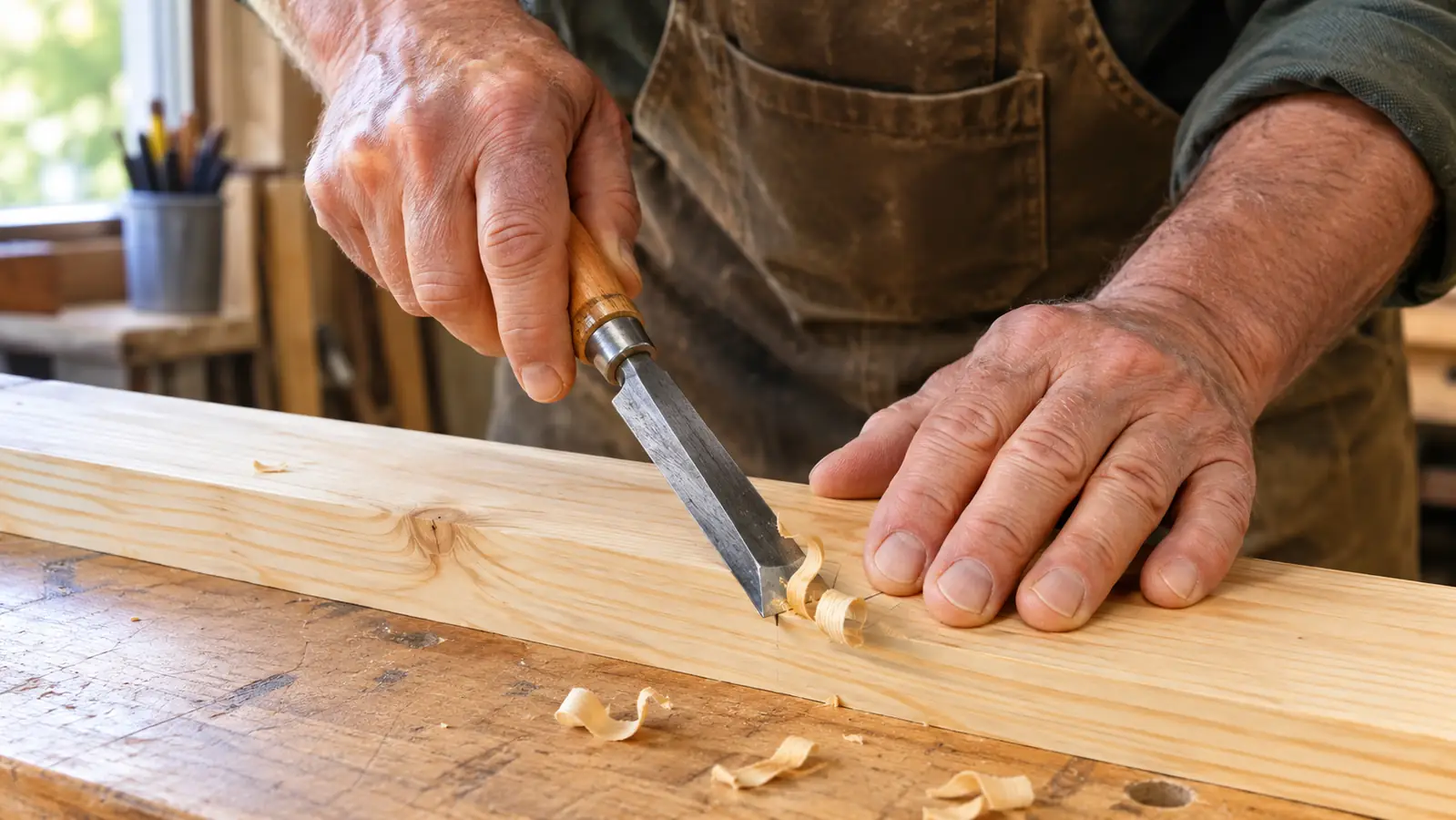
Six sizes for the money is the obvious win, and I am not going to wave it away because it sounds like a numbers argument. The set runs 6, 10, 12, 16, 20 and 26 mm. That range covers everything from cleaning out a small hinge mortise to paring a full inch housing. In my own work the 26 mm saves the most time, because a wide chisel pares a hinge pocket faster than a narrow one and leaves fewer ridges to clean up afterward. Assembling that range one tool at a time is a slower and more expensive way to get to the same bench. A neighbor brought over a five-panel door out of a house built around 1890 last spring, and every hinge pocket on it had been recut at least twice by somebody in a hurry. One mortise was a good eighth of an inch too deep at the back. The only way to fix any of them without tearing the jamb apart was to pare them flat by hand, so I used the 26 mm across the field of each pocket and the 12 mm to clean the corners where the hinge plate sits. Four pockets, about forty minutes, no power tool involved. With a set that had gaps in it I would have had two chisels doing work neither was sized for.
The steel is the second win. Narex uses a chrome-manganese steel hardened to Rc 59, and 59 is a deliberate number rather than a shortcut. It is hard enough to hold an edge through a fair amount of white oak, and soft enough that a water stone brings it back in a couple of minutes. Chisels ground harder hold their edge longer but punish you at the sharpening station, and a hobby woodworker who sharpens once a month does not want that trade. The handles are stained European beech, light and warm in the hand. The set arrives in a wooden presentation box, which matters more than it sounds if your shop runs damp in February.
Where Irwin Marples Wins
The back. When you buy a chisel you are buying a back as much as a bevel, because the back has to be flat for the edge to work at all. Every Irwin Marples chisel I have handled has been closer to flat out of the wrapper than the Narex chisels were. I still lap them, but the time is measured in minutes rather than in an evening. If you have never flattened a back before, that difference is real. The first one you do by hand on a coarse stone teaches you patience whether or not you wanted the lesson.
The handle and the supply. Irwin Marples fits a synthetic handle to most of its bench chisels, and that handle takes a mallet strike, a drop onto a concrete floor and the occasional swipe of dried glue without complaint. Beech is a pleasure to hold and it is not indestructible. I have a one inch Irwin Marples that has lived loose in a canvas bag for years, riding in the back of the truck more often than it should, and the handle has never split. That is not a recommendation for how to store tools. It is an observation about what you are paying for. The other advantage is plain availability. Irwin Marples chisels are sold singly and widely, so losing your 12 mm or needing a second wide chisel for one job is a same-day problem to solve. With a set, replacing a single size means buying the set again or hunting down one chisel from a specialty seller.
Six sizes, one box, and one evening at the stones
The Narex 6 pc Bevel Edge Chisel Set runs 6 mm through 26 mm in chrome-manganese steel at Rc 59, ground at 25 degrees, in a wooden box. If you are outfitting a bench rather than replacing a single tool, this is where I would put the money first.
Amazon Check Today's Price on Amazon →What the Steel Does After a Year
The 25 degree bevel is a working angle, not a display angle. I hone a small secondary bevel at roughly 30 degrees on my water stones, which supports the edge without making the chisel hard to push. On the Narex chisels that routine lasts through a few hours of paring pine and one good session on oak before the edge starts to skate. At Rc 59 a handful of passes on a 1000 grit stone and a few more on an 8000 brings it back to shaving. I have never had to take one back to bare steel on a grinder because the edge gave out. The fairest test I have put it through was four white oak breadboard ends for a small table, cut in February when the shop was cold enough that I carried the stones into the house overnight so they would not freeze. White oak is abrasive and it dulls an edge faster than pine ever will. I honed the 20 mm twice that afternoon, both times on the 8000 stone alone, maybe eight passes each. It never got dull enough to leave a burnished line on the end grain, which is the point where I stop and walk back to the stone.
The bevel edge sides matter more than people expect. The narrow lands along the sides are what let you drop into a dovetail corner without the chisel riding up the wall of the socket. Both of these chisels do that, and both get easier to use the flatter the back is. A chisel with a hollow back will cut, but it steers on you, and steering is what ruins a hinge mortise at the last pass. The first set of pine dovetails I cut with the Narex was a small drawer, eight pins to a side. The sides of the 12 mm were narrow enough that I could get into the corner of each socket without the wall of the chisel riding the pin, and the paring went faster than I expected because I was not fighting the tool for direction. I still chopped the waste out with a narrower chisel first. Anybody who tells you one chisel cuts a dovetail is selling something.
Irwin Marples steel is honest steel, but it rolls sooner on end grain. I find myself touching up more often when I am chopping pine dovetails with one, which is not a complaint so much as a schedule change. Ten minutes at the stones in the middle of a job is the whole difference. If you keep a stone on the bench and use it, you will never notice.
The 26 mm in that set has cleaned out more hinge mortises in century-old houses than every power tool in my shop, and it asked nothing of me but one evening at the stones.
How I Tested These Two
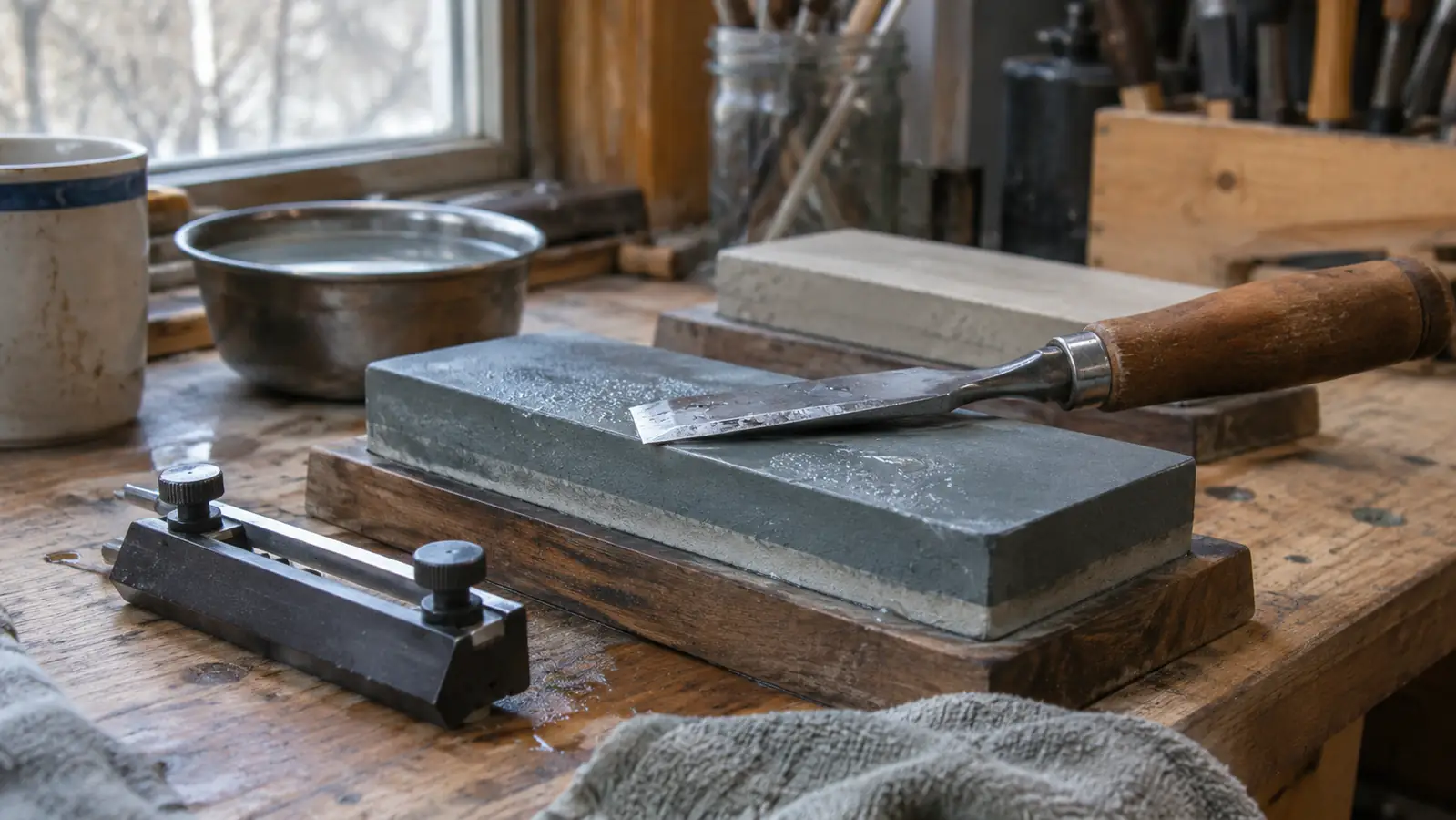
My sharpening station sits by the window of a converted single-car garage, on a bench I built from hard maple. Same stones, same honing guide, same cold mornings with the wood stove doing what it can. I sharpened both chisels the way I sharpen everything: flatten on a coarse stone, work the grits, hone a small secondary bevel, strop. No jigs beyond the guide and no shortcuts with a powered sharpener, because the point was to feel what each chisel does when it is as sharp as I can get it.
Then I put them to work on the jobs I actually get. Hinge mortises in old doors, which is mostly paring and cleaning up someone else's bad cut. Dovetails in white pine, which is a fair test of the sides. Paring end grain on a half-lap repair for a neighbor's barn sill, which is the hardest thing I ask of a bench chisel. That sill had been wet for a hundred years and the end grain was closer to balsa than oak, soft and stringy and full of grit, and it taught me which chisel steers and which one goes where you point it. Neither tool embarrassed itself. The difference showed up in how often I had to stop and go back to the stones, and on the sill job I stopped twice with the Irwin Marples and once with the Narex, mostly because I had let the Irwin edge get a little lazy before I started.
I should be honest about the limits of this. I am one carpenter in one shop, not a testing lab. I do not have a hardness tester and I am not going to pretend I measured anything. What I can tell you is which chisel I reached for without thinking, and why, over a long stretch of ordinary work.
Who Should Buy Which
Buy the Narex 6 pc Bevel Edge Chisel Set if you are building a bench rather than patching one. You get six sizes in one go, a steel that hones quickly, and a box to keep them out of the damp. You will spend an evening flattening backs and you will be glad you did, because you will know your tools afterward in a way that buying a ready-made chisel never teaches you. I say that as somebody who flattened his first set on a plate of glass with wet-or-dry paper because he did not own a coarse water stone yet. That took two evenings rather than one and my shoulders ached for a day afterward. If you have a coarse stone it is a single evening. If you do not, buy the stone along with the set, because the chisels are not much use until the backs are flat. This is the set I would hand a returning woodworker who has decided to stop borrowing tools.
Buy Irwin Marples if you want one chisel, today, and you want it close to ready. If your work is occasional, if you mostly need a half inch chisel for hinge work and a quarter inch for cleaning corners, a set of six is more tool than you will use and more setup than you want. Buy the two sizes you need, keep them sharp, and put the saved evening into building something.
The third option, and the one I actually live with, is both. The set stays on the rack for the sizes I do not use often, and a couple of Irwin Marples chisels sit out on the bench for the work I do every day, so a dull edge does not stop me while I get around to honing. That is not indecision. It is having a spare tire.
The set that made me stop borrowing chisels
Six metric sizes, chrome-manganese steel at Rc 59, a 25 degree bevel and a wooden box. Flatten the backs once and you will not think about the tool again for years. Mine have been on the rack since the day they arrived.
Amazon See the Narex Set on Amazon →