

The short answer is that these two are not rivals, and treating them as rivals is how a person ends up with a drawer full of sharpening gear and a bench full of dull chisels. The King KW65 is a combination water stone, 1000 grit on one face and 6000 on the other, and its job is the last third of the work: turning an edge that is already sound into one that pares end grain clean. A diamond plate is a steel plate with diamond grit bonded to the face, and its job is the first third: taking a chipped, rounded or badly abused edge and giving it a shape worth polishing. I keep both within arm's reach. If someone made me choose one, I would keep the King and borrow a plate twice a year.
That is the tidy answer, and it does not help much when you are standing in the aisle trying to decide what to buy first. So here is the version that helps. Go and look at your worst chisel. If the edge is chipped, or the bevel is rounded over from years of being dragged across a grey oilstone, buy a diamond plate first. If the edge is straight and merely dull, and what you want is a cleaner, sharper edge than you have ever managed, buy the King and learn to use it. The rest of this is the reasoning behind those two sentences.
| King KW65 | Diamond plates | |
|---|---|---|
| What it is | Ceramic water stone, 1000 grit on one face and 6000 on the other, 8 x 2 x 1 inches, 16 ounces, with a sturdy plastic base | Steel plate with diamond grit bonded to the surface, usually bought as a coarse plate and a fine plate |
| Speed on a nicked or rounded edge | Slow. The 1000 side will get there, but you will be at it a while | Fast. Diamonds cut hard steel without arguing about it |
| Final polish on a chisel or plane iron | The 6000 side leaves a bright, near mirror bevel that pares end grain clean | Fine plates cut a working edge, not a polished one |
| Flatness | Water stones dish in the middle and need flattening on a plate or a sheet of wet and dry paper | Flat out of the box, and it stays flat until the grit wears out |
| Setup before you sharpen | Needs water, and I stand mine in a tray for a few minutes before I start | A splash to float the swarf off and you are working |
| Feedback while you work | You can hear and feel the bevel sit down flat on the stone, which is how you learn an angle | A dry rasp and not much else. The plate does not tell you much |
| Hard alloy steels such as A2 and D2 | Works, but slowly, and the stone wears faster for the trouble | This is what diamond is for |
| How long it lasts | Years of hobby use if you keep it flat and do not gouge it | The diamonds dull and shed, and a worn plate turns into a slow scraper |
| Best for | Chisels and plane irons that are already in decent shape and need a finer edge | Rescuing damaged edges, flattening backs, and touching up on site |
Where the King KW65 Wins
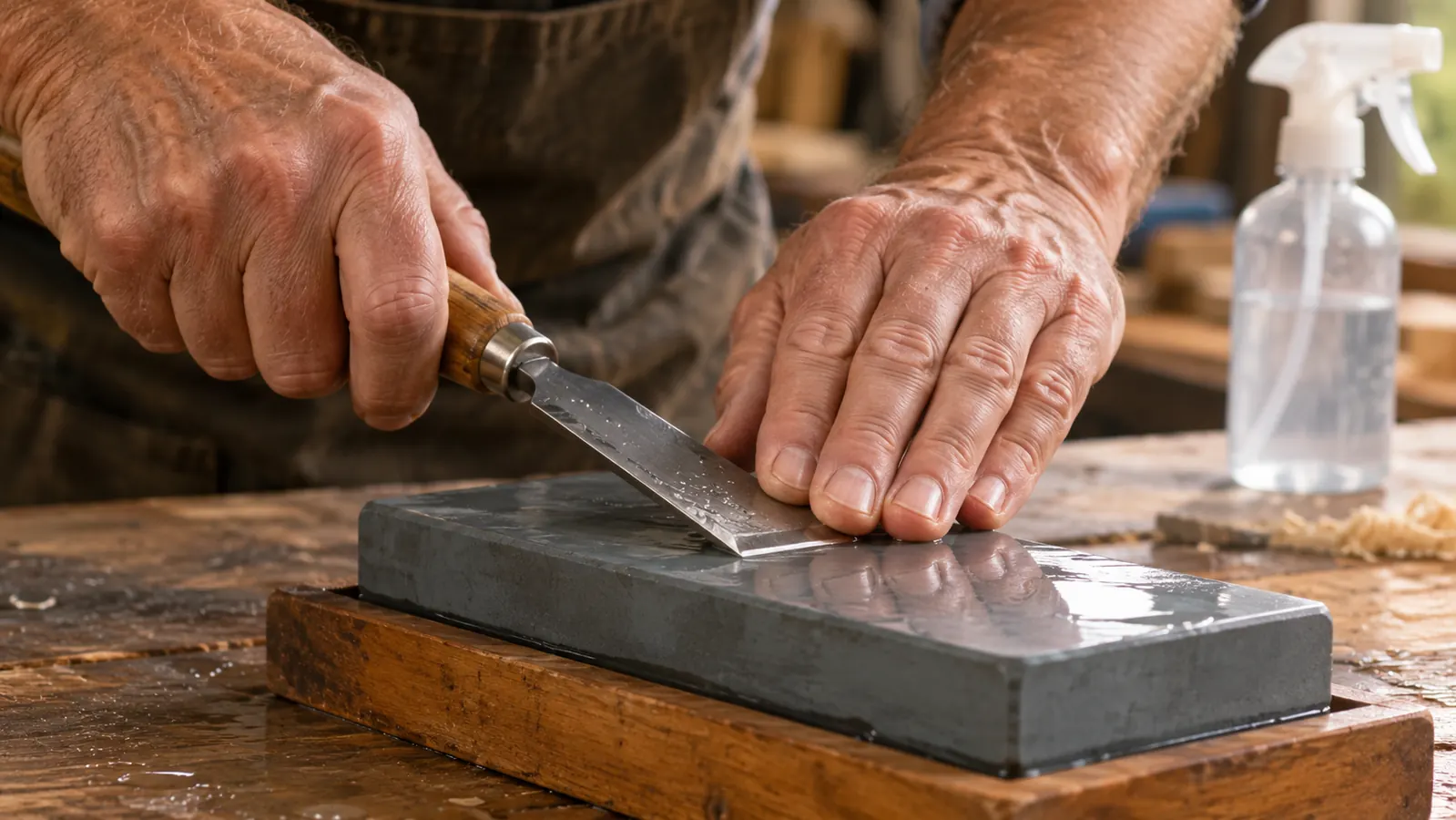
Start with the finish, because that is what you are buying. The 1000 side is a working grit. It removes metal, it re-establishes the bevel, and it raises a burr, which is the thin wire of steel that curls off the back of the edge once you have worked one side enough. The 6000 side is where an edge stops being a scraper and starts being a cutter. A chisel finished on the 6000 face will pare the end grain of white oak and leave a surface that looks sanded. The same chisel off a fine diamond plate will cut, and cut well, but you can feel the difference in the first inch.
The chisel I proved that on was a half inch bevel edge I picked up at a flea market in Wakefield, one of a bundle of five with handles that had been hammered loose and re-seated badly. I flattened the back on a coarse plate first, then took that one chisel through the King in a single sitting. Same chisel, same afternoon, same white oak offcut. The difference between the 1000 face and the 6000 face was the clearest thing anyone ever showed me about what sharpening is actually for.
The second thing is feel. A water stone talks to you. The sound changes when the bevel sits down flat, and you can feel the slurry of spent grit building under the blade as you work. That is the feedback that teaches you to hold an angle, and holding an angle is the whole skill. A diamond plate gives you a dry rasp and not much else. I learned on oilstones, and the first good water stone I used told me how much of my sharpening had been guesswork.
There is also the plain convenience of one object doing two jobs. The stone is 8 inches long, 2 inches wide and 1 inch thick, and it weighs 16 ounces, so it lives in the corner of the bench and does not need to be put away. It comes with a sturdy plastic base, which matters more than it sounds like it should, because a stone that slides while you are pushing a plane iron across it will teach you bad habits quickly. Two grits on one stone means no juggling and no second holder.
A chisel finished on the 6000 face will pare the end grain of white oak and leave a surface that looks sanded.
And then there is life span. A water stone does wear. It dishes, meaning the middle hollows out, and it wants flattening from time to time. But a stone that is kept flat and not gouged will outlast most of the diamond plates sold to hobbyists. Diamond grit does not stay sharp forever. It dulls, it sheds from the bond, and a tired plate becomes a slow, grabby scraper that you keep reaching for because you paid for it. I have thrown away more plates than stones.
Where Diamond Plates Win
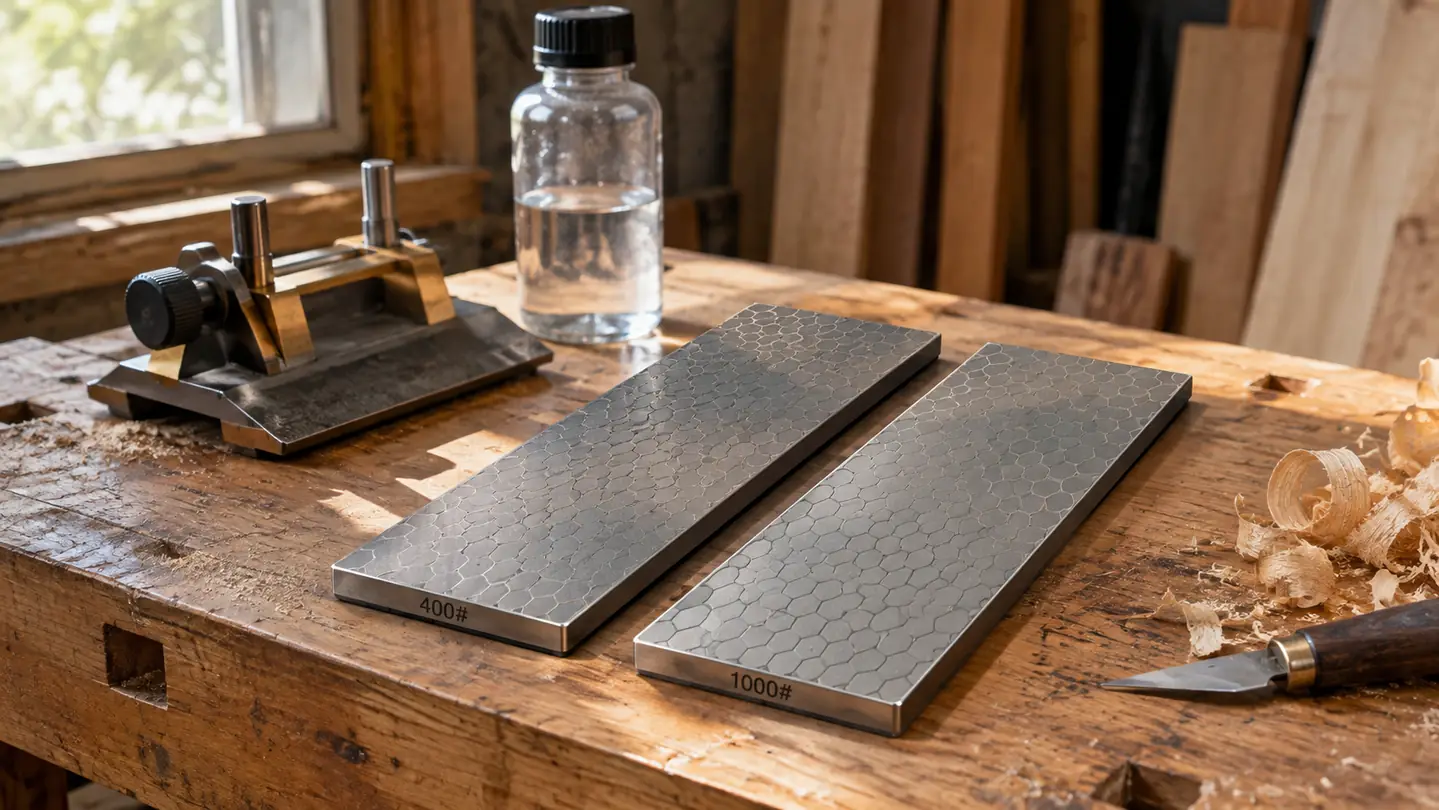
Now the concessions, and there are real ones. The first is speed on a damaged edge. Diamonds cut steel without caring how hard it is. A chipped chisel that would take me fifteen minutes on the 1000 side of the King, plus a sore forearm, comes back to a clean shape on a coarse diamond plate in about two. If you sharpen for other people, or if you buy old chisels at yard sales the way I do, that gap is the whole argument.
Two winters ago a neighbor brought over a set of chisels out of his father's shop. Four of them, every edge rounded over like a spoon, and one with a nick in it you could have hung a coat on. I shaped all four on the coarse plate in under ten minutes and sent him home with them. That same afternoon on the King would have run to an hour and a half, and I would have had to stop and flatten the stone in the middle of it.
Second, flatness. A diamond plate is flat when you take it out of the box and it stays flat until the grit gives out. That matters most for the least pleasant job in the shop: flattening the back of a chisel or a plane iron. The back has to be flat along its length or the edge will never seat, and a coarse plate does that work in a fraction of the time a stone takes. It is also what I use to flatten the King when the middle starts to hollow, because a stone cannot flatten itself.
Third, no soaking and no mess. I stand the King in a tray of water before I start and I work with a puddle on the surface. A diamond plate needs a splash to float the swarf off and that is the end of the preparation. And on the harder alloy steels, A2 and D2 and the powder steels that turn up in a lot of modern plane irons, diamond is simply the right tool. The King will cut them, but it is slow about it and the stone wears faster for the trouble.
I will not pretend a plate is indestructible, because it is not. The diamonds dull, they shed from the nickel bond, and a worn plate is worse than a fresh stone in one specific way: it still feels like it is working. Treat a good plate as a five year tool, not a lifetime one, and you will not be disappointed by it.
The stone that finishes what a plate starts
The King KW65 puts a 1000 grit working face and a 6000 grit polishing face on one 8 inch stone, with a base that holds it still while you push a plane iron across it.
Amazon See Today's Price on Amazon →How the Two Work Together on One Edge
Here is the sequence I use on a chisel that has had a hard life. Coarse diamond plate to take out the nick and set the bevel angle. Fine plate to refine that shape. Then the King, 1000 side to raise a burr along the whole edge, 6000 side to polish the bevel and then the back, alternating, until the burr comes off clean. The whole thing runs about eight minutes now, and four of those are on the stone. Ten years ago it took me half an hour and the edge was worse.
For a chisel that is only dull, the plates stay in the drawer. Ten passes on the 6000 side, the back laid flat on the stone, and back to the work. That is the part people leave out of the stones versus plates argument. Most of the time you are not sharpening, you are touching up, and a stone is better at touching up. It is gentler on the steel, it leaves a finer edge, and it takes less off.
I count those passes, which sounds fussy and is not. Ten on the bevel, ten with the back flat on the stone, then straight back to the work. It takes about ninety seconds and it is the difference between a chisel that cuts and a chisel that skids across the surface. Do it at the start of a session and again an hour in, and the edge never gets far enough gone to need the plates at all. That habit is worth more than any tool I have bought.
I spent my first few years sharpening on whatever happened to be in the shop, which was an old oilstone with a hollow in the middle deep enough to hold a pencil. Nobody told me it was dished. I assumed I was bad at sharpening, and I sharpened badly for a long time because of it. A flat surface is the beginning of the whole business. If you take one thing from this, take that one.
What Goes Wrong If You Skip One
Skip the plate and the King slowly goes out of flat. Water stones hollow in the middle, and a hollow stone grinds a crown into your bevel that you cannot see and can definitely feel. The chisel cuts for a while and then stops cutting, and you blame your technique. Flattening takes two minutes with a coarse plate or a sheet of wet and dry paper on a flat tile. Most people never do it, and that is the single biggest reason water stones get a bad reputation.
The tile I use came out of the leftover pile on a job back in 2009 and it has never moved. Spray adhesive, paper down flat, ten figure eights with the stone face down, then check it. I draw a pencil grid across the face first. If the lines are gone evenly, the stone is flat. If the lines in the middle are still there, the middle is still hollow and I keep going. That grid is the whole trick and it costs nothing.
Skip the stone and your edges stay coarse. A chisel straight off a fine diamond plate is sharp enough to cut pine and sharp enough to shave, and it will still tear the end grain of white oak, because at that scale the edge is a row of tiny saw teeth. The 6000 face is what smooths those teeth off. You will not notice the difference on construction lumber. You will notice it the first time you cut a dovetail in hardwood and look at the shoulder.
What I did for years was neither. I had one hollow oilstone and a leather strop and I made do. My joinery was acceptable, it took me twice as long as it should have, and I did not understand why until I watched a man sharpen a chisel properly and then watched him cut with it. The edge does most of the work. Everything else in the shop is just holding it steady.
Who Should Buy Which
Buy the King first if your edges are sound and your real problem is that they are not sharp enough. That covers most hobby woodworkers, most of the time. You get a 1000 grit face for setting a bevel and a 6000 grit face for finishing it, the stone is 8 inches by 2 inches by 1 inch and weighs 16 ounces, and it comes with a base. Learn to keep it flat with a sheet of wet and dry paper on a flat tile, or with a coarse plate if you have one, and it will serve you for years.
Buy a diamond plate first if you are starting from chisels that have been abused, if you flatten a lot of backs, or if you work the harder modern steels. Buy a coarse one and a fine one if you can, because a single plate will not cover both jobs well. And if you can manage both, buy both and use them in the order above. That is not a compromise. It is how the work is actually done in a shop where the tools have to earn their keep.
Start with the stone that does the last third
One stone, two grits, 8 inches of ceramic that sits in its base and stays put. If your chisels are straight and merely dull, this is where to begin.
Amazon Check the King KW65 on Amazon →