
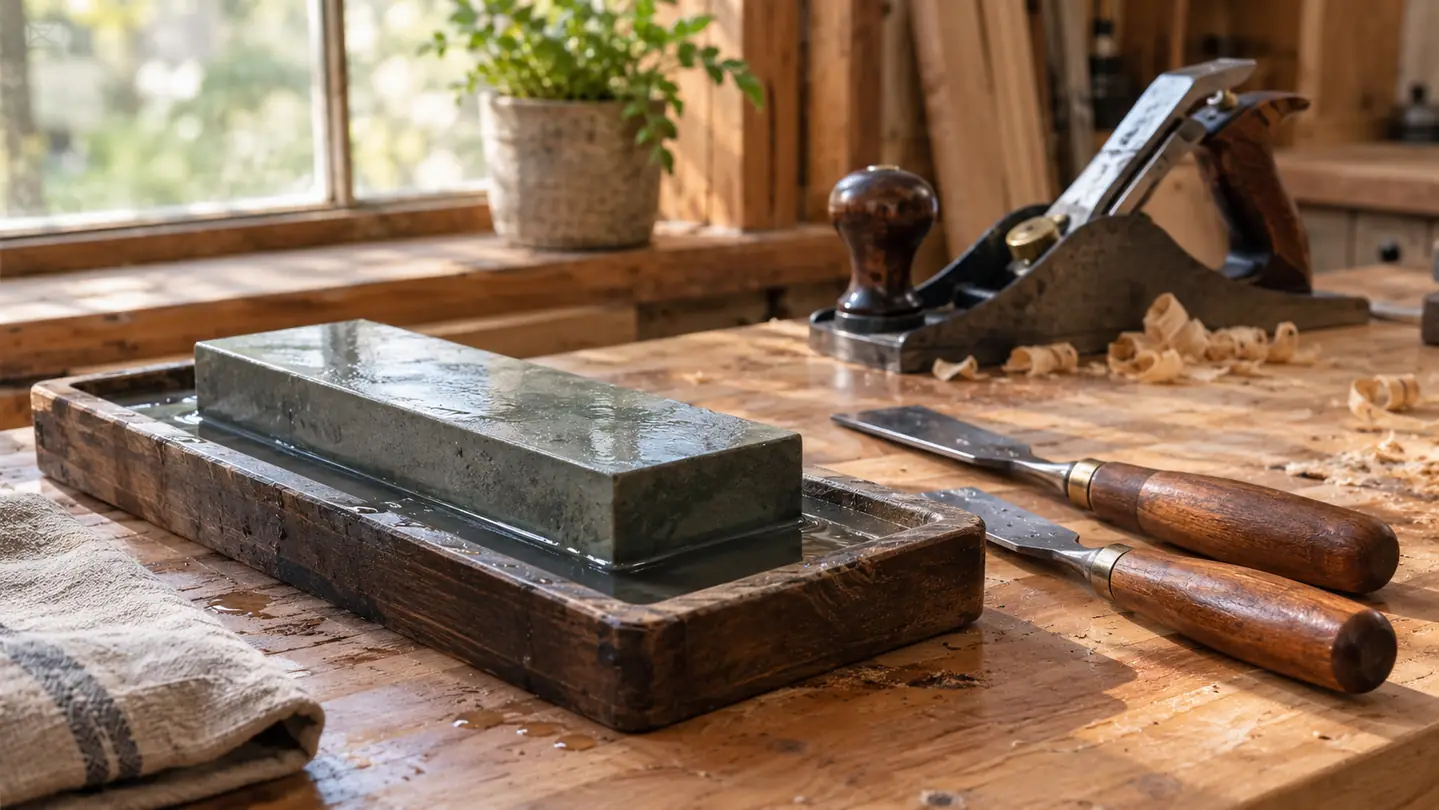
For most of my working life I sharpened on whatever was nearest. A slip stone, a splash of oil, a leather strop tacked to the bench leg. That was fine when I was cutting pine trim in other people's houses, because pine forgives almost anything. Then I retired, built myself a maple bench, and started making small boxes out of hard maple and cherry. The wood stopped forgiving me.
The trouble was not the bevel. Everybody learns to rock the bevel and call the edge sharp. The trouble was the back of the iron. A chisel with a hollow back carries a curved edge, and a curved edge will not pare a clean corner no matter how many times you go back to the stone. Flattening a back takes a flat stone, plenty of water and a certain stubbornness. I had two of the three.
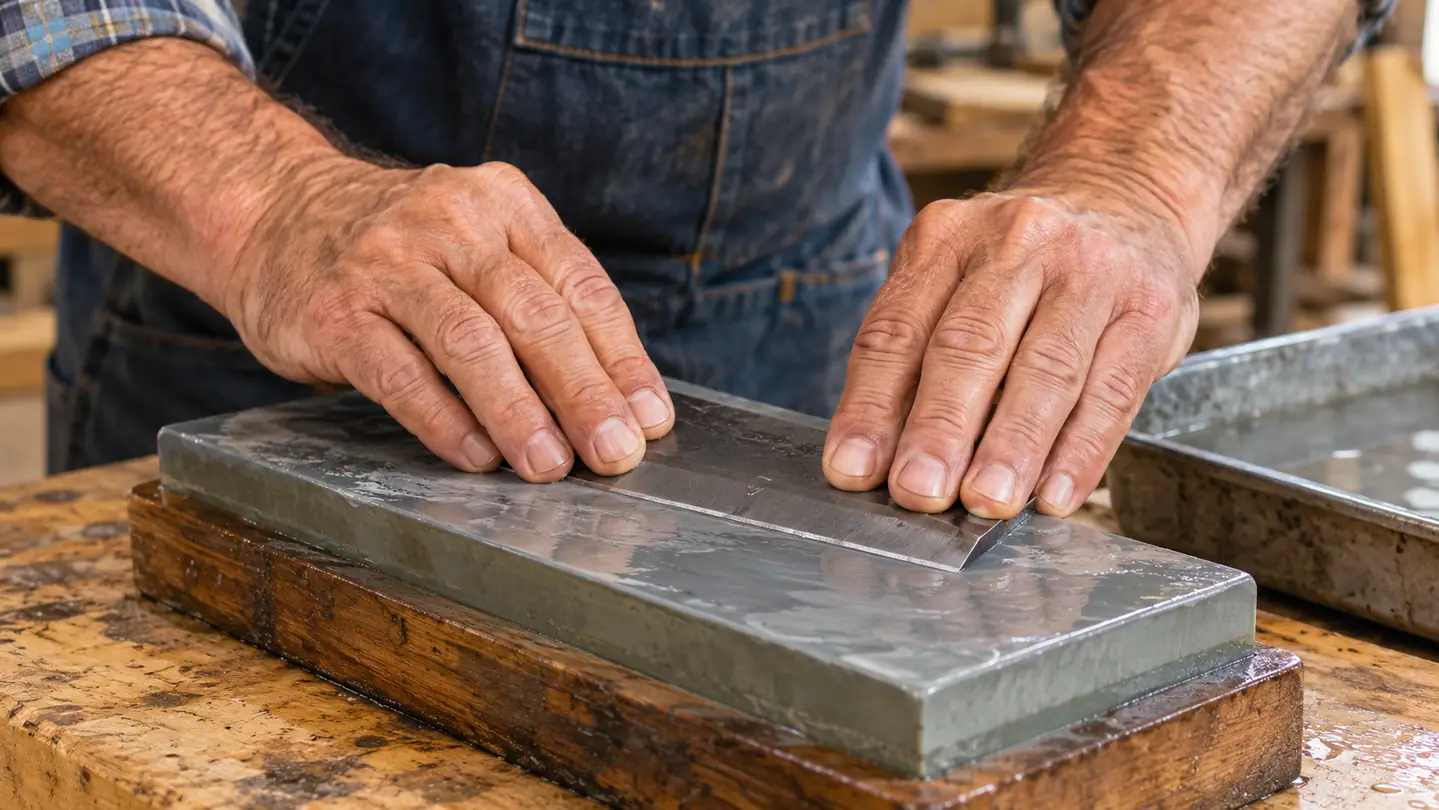
A luthier two towns over let me try his King KW65 at his bench one afternoon. He sharpened guitars, not cabinets, but an edge is an edge. What struck me was how little fuss there was. He splashed water on the stone, worked the back of a plane iron for a few minutes, and the grey slurry that came up told him everything he needed to know about how the job was going. I ordered one that week.
The King KW65 is a combination waterstone, 1000 grit on one face and 6000 on the other, cut in an 8 inch by 2 inch by 1 inch block and weighing 16 ounces. It comes with a sturdy plastic base, which matters more than it sounds. A stone that slides around while you are pressing an iron against it is a stone that will teach you bad habits about pressure. This one sits still in its base, and the base doubles as the holder when you flip the stone over.
Sixteen ounces is heavy enough to feel solid under your hands and light enough to carry to the sink and back. It lives in a shallow tray of water by the window, and it has lived there for a good while now.
The 1000 grit does the work. The 6000 grit only makes the work visible.
One stone, two grits, and a base that stays put
The King KW65 has been sitting in a tray of water by my window since the week it arrived, and it is the first thing I reach for when an edge goes off. 1000 grit to do the work, 6000 to prove it.
Amazon Check Today's Price on Amazon →The 1000 side is the working side. I hold the iron flat on the stone, fingertips spread across the width so the pressure stays even, and push away from me in long strokes until the whole back is grey with slurry. Then I check it against the light. A back that is genuinely flat reflects light in one continuous sheet, edge to edge, with no dark smudge at the corners. That check takes four seconds and it has saved me more rework than any jig I have ever bought.
The 6000 side is not really a sharpening grit. It is a checking grit. Ten or twelve passes per face, the slurry goes thin and pale, and any scratch left over from the 1000 side shows up bright against the polish. If I can still see a scratch after the 6000, that means the 1000 work was sloppy and I go back and do it properly. It has taught me to be honest about the first step, which is not a lesson I would have taken from a book.
Waterstones wear. Mine has dished a little in the middle over a couple of years of steady use, and that is not a defect, it is the nature of the thing. I flatten it now and then on a sheet of wet paper on a glass plate, five minutes, and it is dead flat again. The plastic base comes off for that. All of the maintenance is unglamorous and takes about as long as making a pot of coffee.
What it does not do well is speed. If I am at a neighbor's house and a plane iron needs a touch-up between cuts, the stone stays home. A diamond plate is faster for that and I use one. The King is a bench tool, and it wants to be at the bench, near water, with the iron already off the plane. Treat it as part of the setup and it earns its place. Treat it as something to dig out of a drawer and you will keep reaching for the wrong thing.
One more thing worth saying. A combination stone is a compromise in the way a combination square is a compromise. It does two jobs on one block, and it does both of them well enough for furniture work. If you sharpen for money, or you are flattening the backs of a dozen chisels in an afternoon, you will want separate stones and more room on the bench. If you are like me, one bench, a dozen chisels, an hour on a Saturday, the 1000 and the 6000 cover nearly everything I cut.
What I'd Tell You If We Were Sitting at My Kitchen Table
I would tell you to buy the stone before you buy the jig. Everybody wants the gadget that holds the angle for them, and the gadget is fine, but it will not flatten a back, and the back is where most dull edges actually come from. Learn to feel the stone cut. Learn to read the slurry and the light. The angle takes care of itself with a little practice. That is not a popular answer because it costs you an evening. It is still the right one.
And I would tell you that a sharp edge changes how you work. When honing takes five minutes instead of a half hour of dread, you stop saving the good chisel for special occasions. You pare the corner, you check it, you pare it again. The work gets quieter. That is the part I did not expect when I set the King down on the bench by the window, and it is the part I would miss most if it went away.
If your edges are fighting you, start with the back
One stone, two grits, and a base that stays put. The King KW65 is the plainest fix I know for a chisel that will not pare.
Amazon Check Today's Price on Amazon →