
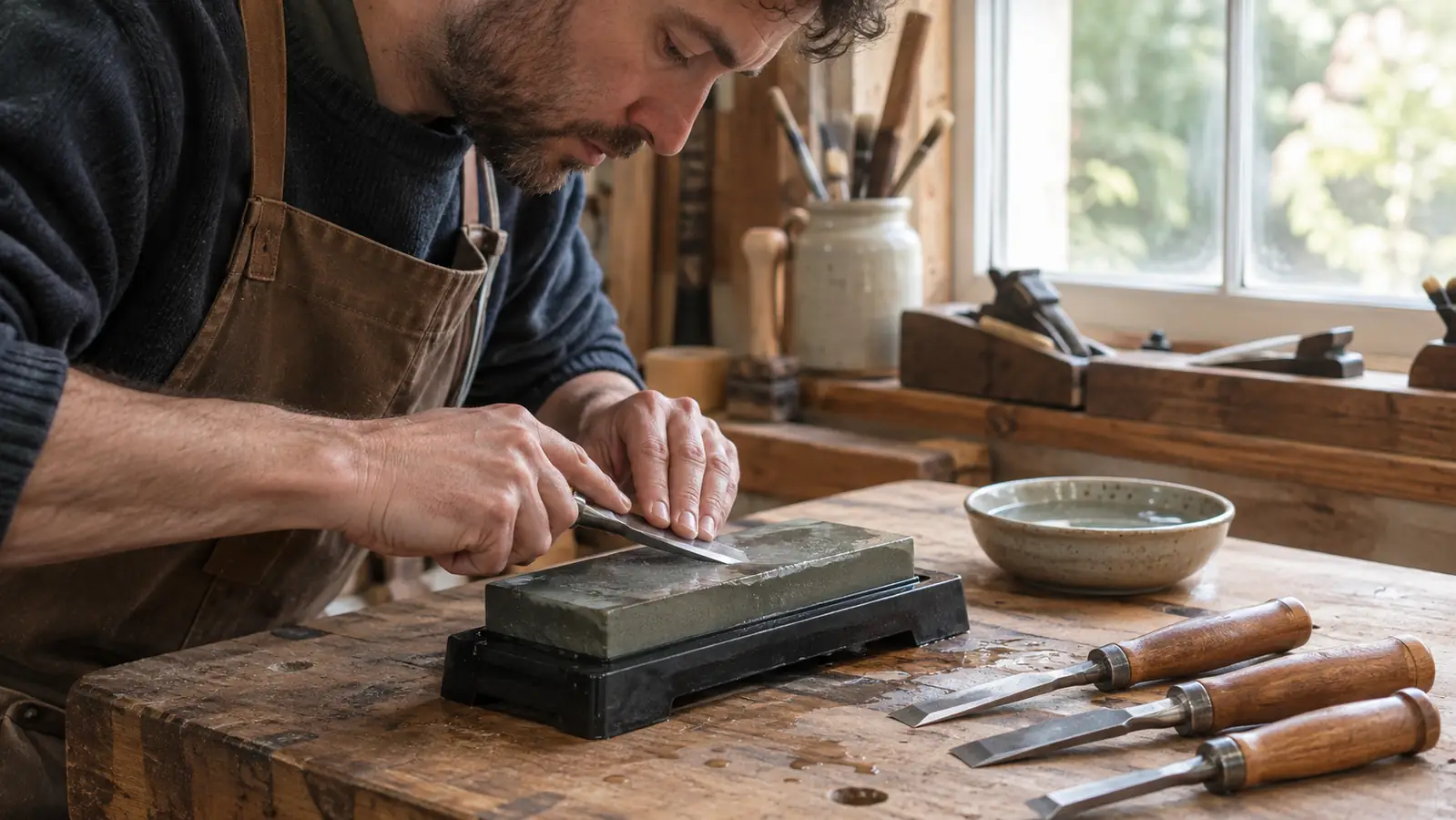
The King KW65 arrived in my shop carrying a reputation that had done most of the talking before I ever unwrapped it. Every sharpening video I watched over one winter seemed to have this same stone sitting on the bench, and once you see a thing that often you stop evaluating it and start assuming it. I have been sharpening chisels and plane irons for close to forty years, much of that on oil stones and, later, on diamond plates, so I did not need convincing that a whetstone can work. I needed convincing that this one earned the space on the sharpening station by my window.
Here is the short version. The King KW65 is a 1000/6000 grit combination waterstone, ceramic, 8 inches long, 2 inches wide and 1 inch thick, 16 ounces on the scale in my shop, and it sits in a sturdy plastic base. It has better than four and a half stars across more than seven thousand ratings, and after using it I understand why. It is also softer, thirstier and messier than the praise lets on, and there are parts of owning one that the enthusiasts skip past entirely.
The Quick Verdict
A good two-sided waterstone that rewards a light hand and punishes impatience. It dishes, it drinks water, and it will still put a working edge on a chisel.
Amazon Check Today's Price →The Stone Half of Us Actually Started On
1000 grit to raise the burr, 6000 to refine it, one stone on the bench instead of two. Check the current listing and today's price on Amazon.
Amazon Check Today's Price on Amazon →How I've Used It, and on What
My bench is hard maple, built maybe fifteen years ago, and the sharpening station is a slab of scrap granite by the window, partly because the light is best there and partly because stone slurry wipes off granite easier than it wipes off wood. Most of what I sharpen now is furniture work: chisels from a quarter inch up to an inch and a half, and the irons from two bench planes and a block plane. I still get the occasional neighbor's door hardware or a sash tool somebody found in a barn. The King has handled all of it. Nothing I own is exotic steel, and nothing I own is so hard that it fights a stone.
The routine is the one my first boss taught me. I set the stone in its base, I put water on it, and I work the bevel until I can feel the burr roll over on the back. That burr is the whole point of the 1000 side. Until it is there, uniform and running the full width of the edge, the bevel is not finished, and no amount of polishing on the fine side will save it. The King raises that burr quickly on a chisel that has been let go, and it raises it in a way you can feel through your fingers rather than guess at.
Different steels behave a little differently on it, which is worth knowing before you blame the stone. The older chisels I use, the ones with laminated backs, feel soft and pleasant on the 1000 side and raise a burr in a dozen strokes. Newer production chisels with harder alloys take longer and want a lighter touch, and if you lean on them the stone wears faster than the steel does. Neither is a problem. It just means you sharpen by feel rather than by counting strokes, which is what you should have been doing all along.
Then I turn the stone over. The 6000 side is where the edge stops being a shape and starts being an edge. A dozen light strokes with the bevel flat, a few more with the back flat against the stone, and the scratch pattern from the coarse side goes away and the steel goes bright. I finish by pulling the chisel across a piece of scrap hardwood. If it bites and leaves a clean, glossy shaving rather than dust, the edge is done. That test has never once lied to me.
What Nobody Tells You About the 1000 Side
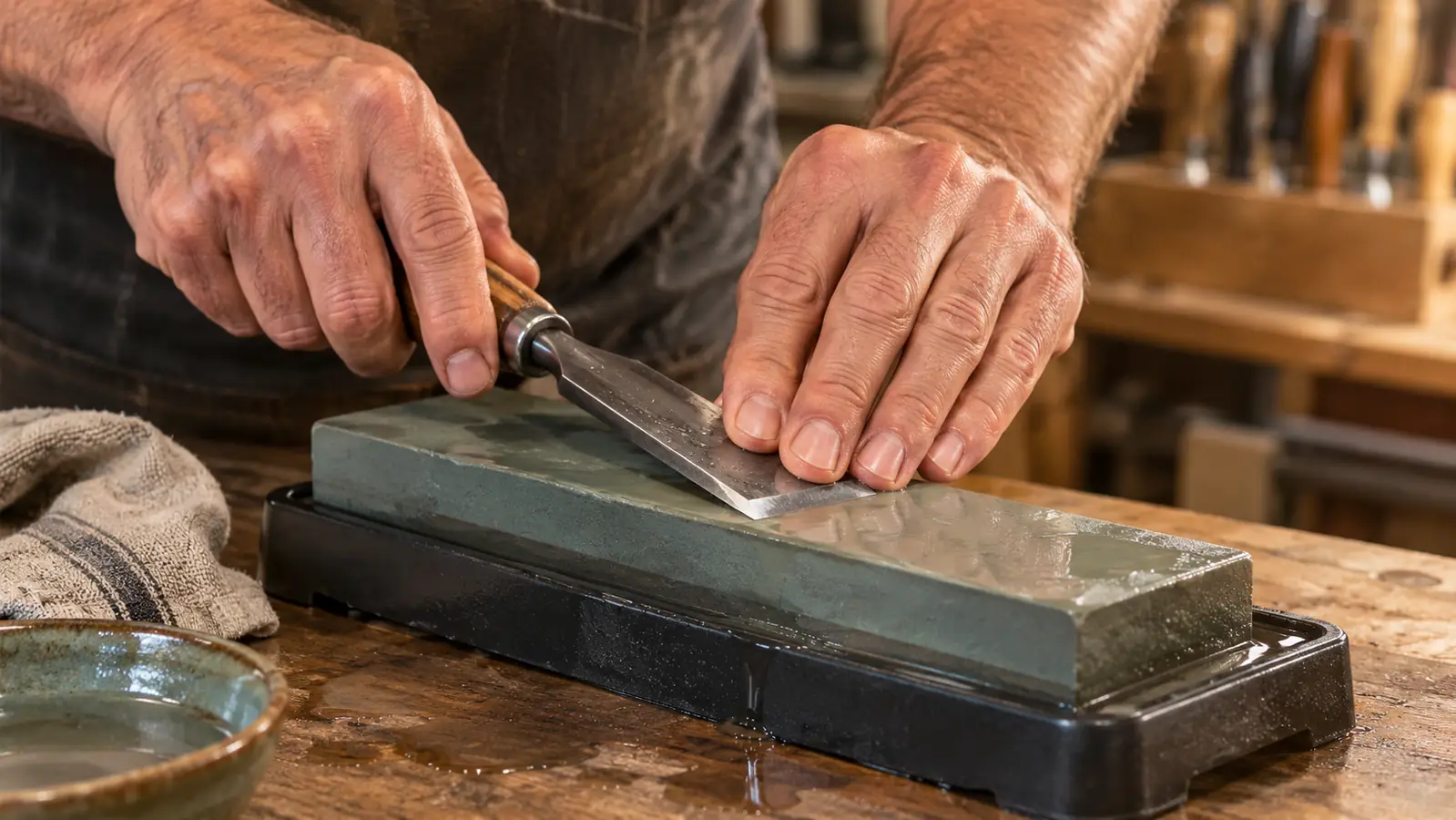
The coarse side is soft. Not soft in a defective way, soft in the way most Japanese-style waterstones are soft, and it means the stone wears as you work. Work a wide plane iron across the middle of the stone for a while and you will see the surface dip. That dip is called dishing, and once it is there, every edge you sharpen inherits the curve. A chisel sharpened on a dished stone comes off with a slightly crowned bevel, and a plane iron comes off with an edge that is not square to its sides.
This matters more than any other single thing about the King KW65, and it is the thing I most wish had been said to me plainly. The stone is not a permanent flat surface. It is a wear item that needs to be brought back to flat every few sharpenings, and how often depends on how much you press. Press hard and you can dish it in one session. Let the stone cut and it stays flat far longer. Learning to let the stone do the work is worth more than any jig you can buy.
I flatten mine on a coarse diamond plate under running water, drawing a pencil grid on the stone and working until the grid is gone. That is the honest method and it works. If you do not have a diamond plate, a sheet of wet and dry paper on a flat tile does the same job more slowly and with more mess. Either way, budget the time for it. A combination stone without a way to flatten it is half a tool, and that holds true for the King and for every other waterstone of this kind.
The 6000 Side Is a Refinement Stone, Not a Finishing Stone
Six thousand grit sounds like the end of the road if you came up on oil stones that stop at fine. It is not the end of the road. It is a good working polish that leaves a fine, slightly hazy surface, and for chisels and bench planes that is exactly what you want. What it is not is a mirror. If you are chasing a mirror you will need something finer and you will spend a great deal more time for a difference you cannot feel in the cut. I have never once finished a piece of furniture and wished my edge had been shinier.
The 6000 side also loads up. Soft steel and light pressure will leave grey slurry packed into the surface, and a loaded stone stops cutting. Keep water on it, keep a rag handy, and do not be afraid to rinse it. The other thing about the fine side is that it is unforgiving of a bad angle. Rock the chisel even a little and the fine side shows it immediately as a facet that catches the light differently from the rest of the bevel. That is annoying at first and useful later, because it teaches you to hold an angle.
The jump from 1000 to 6000 is fine for maintaining an edge that is already in decent shape. It is a long jump for repairing a chipped or badly rounded bevel, and no amount of patience on the 6000 side will fix work that should have been done coarser. If you buy chisels at flea markets the way I do, plan on a coarse stone or a diamond plate for the rehabilitation and treat the King as the stone that follows. Two stones and a plate is the honest kit. One combination stone is the starting kit, and that is a different claim.
A chisel sharpened on a dished stone comes off with a crowned bevel, and no amount of polishing on the fine side will fix it.
The Base, the Footprint, and the Small Annoyances
The sturdy plastic base the stone comes in does its job of holding the stone off the bench and giving you something to grip, but it does not grip the bench. Waterstone slurry is slippery. Set the base on a bare bench top and it will walk while you work, especially with the long strokes you use on a plane iron. I keep a damp rag under mine. Some people set the base in a shallow tray or clamp a batten in front of it. Whatever you choose, choose something, because the first time the whole assembly slides you will bark your knuckles.
The footprint is the other thing to think about before you buy. Eight inches long and 2 inches wide is a sensible size for chisels and for irons up to about two inches. It is narrow for anything wider, and if you sharpen a lot of wide iron you will find yourself working diagonally, which is fine as a technique but not as a habit. The inch of thickness is a genuine virtue. That is a lot of stone to wear through, and even with regular flattening it will outlast the years I have left to sharpen in.
Sixteen ounces is light. That sounds like a small point and it mostly is, but it means the stone travels well if you ever want to take it somewhere, and it also means it is easy to knock off the bench. Mine has hit the garage floor once. It survived, which says something for a ceramic stone an inch thick, but I would not make a habit of it. The stone also stays wet for a while after you finish, and putting a wet stone away in a drawer is how you end up with a stone that smells like a pond.
Drying is the last small chore. Stand it on edge somewhere with air around it rather than laying it flat on a bench, and let it dry overnight before it goes back in the base. A stone that lives permanently damp will grow things you do not want in a shop, and a stone that dries too fast in front of the wood stove is worse. Mine lives on a scrap of pine on a shelf above the bench, away from the stove, and it has been fine for the years I have had it.
What It Actually Does to an Edge
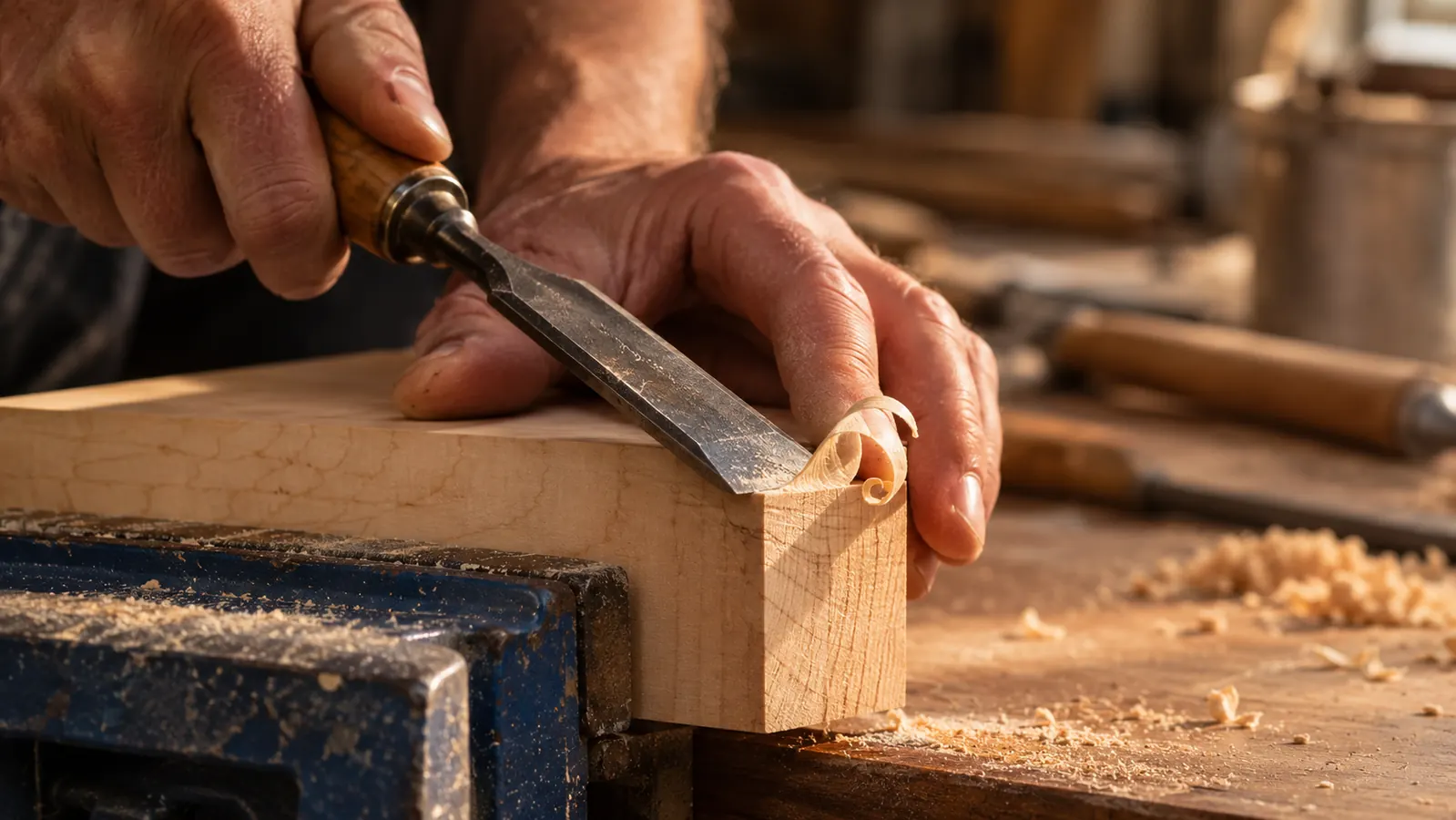
The proof of any stone is in the cut, so here it is. A half inch chisel that came to me with a rounded bevel and a nick in the edge took about four minutes on the 1000 side to get back to a clean, straight edge with a full burr. Another two minutes on the 6000 side and it would pare end grain on a scrap of maple, taking a shaving you could read through rather than crushing the fibers. That is the standard I care about. A sharp edge severs wood. A dull one bruises it, and you can see the bruise on end grain from across the shop.
Pine is the more honest test in some ways, because a soft wood punishes an edge that is merely sharp-ish by tearing the latewood instead of slicing it. I keep a piece of clear pine on the bench for exactly that. The King gets a chisel to where it will pare pine end grain and leave a surface that looks polished rather than scraped, and it does that without any of the intermediate stones some sharpening advice insists are mandatory. Fewer steps, more attention at each step. That is the trade this stone offers.
What the King does not do is remove a lot of steel fast. If you are restoring a chisel that somebody abused with a grinder, this is not the tool for the rough work, and it will take you a long evening to do what a coarse diamond plate does in ten minutes. Where the King earns its place is in the middle of the job: after the shape is right, before the edge is finished. That is where most of us spend most of our sharpening time, and it is where a combination stone in the 1000 to 6000 range makes the most sense.
What I Would Tell a Beginner Before Buying
Soak it before the first use and give it a good long drink, then keep water on it as you go. Flatten it before you trust it, and flatten it again when the middle starts to dip. Use light pressure and let the abrasive cut rather than trying to force it. Accept that the mess is part of the deal, because it is, and that a stone this size will want a rag, a tray and a place to dry. Do all of that and the King KW65 will put a good edge on anything with a bevel. Skip it and you will decide the stone is no good when the truth is that the stone was never the problem.
What I Liked
- Cuts quickly enough that a routine touch-up takes a few minutes
- Two grits on one stone, so the bench stays clear
- An inch thick, with plenty of life left in it
- The 6000 side leaves a clean working polish for chisels and plane irons
- Ships in a sturdy plastic base that holds it steady off the bench
Where It Falls Short
- The 1000 side dishes and needs flattening regularly
- The base slides on a bare bench top
- Two inches wide is narrow for wide plane irons
- The 6000 side loads up and needs rinsing
- Not coarse enough to rehab a damaged bevel on its own
Who This Is For
This is a stone for someone who already sharpens, or who is willing to learn properly. If you keep chisels and a plane or two and you want one stone on the bench that handles both the shaping and the refining, the King does that job without drama. It suits a hand-tool woodworker in a small shop who does not want a rack of stones. It also suits the person who has been sharpening on sandpaper over a plate of glass and is tired of buying paper. Both of those were me at different points, and both would have been well served by this stone.
Who Should Skip It
Skip it if you want a stone you never have to flatten, because that stone does not exist and this one certainly is not it. Skip it if you do a lot of restoration and need to take chips out of abused edges, because the coarse side is not coarse enough for that and you will want a diamond plate first. Skip it if you work in a space where water and grey slurry are not welcome, or if you simply will not maintain a stone. And skip it if you want a mirror polish, because 6000 grit is a working finish, not a display finish.
One Stone, Two Grits, and a Flatter Surface You Have to Earn
If you want the stone that made half those sharpening videos worth watching, this is it. Check the current listing and today's price on Amazon.
Amazon Check Today's Price on Amazon →