
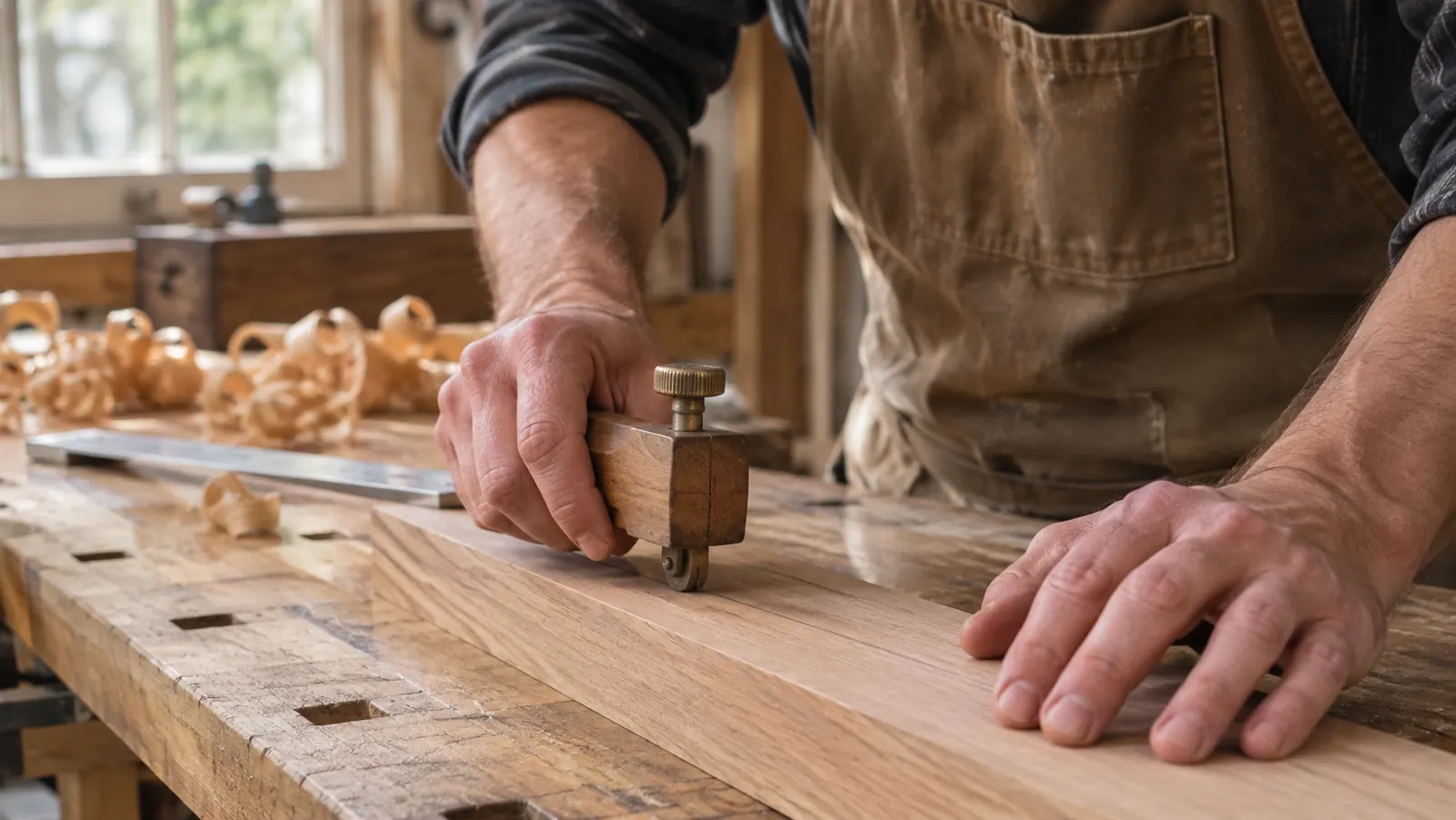
For about fifteen years my marking gauge was a brass-headed thing handed down from the carpenter I apprenticed under, and the pin on it had been blunt for at least ten of those years. I knew it. I kept using it anyway. A dull pin tears the wood fibers instead of slicing them, so the line comes out fuzzy, and a fuzzy line is a line you end up guessing at with a chisel already in your hand. Last winter I bought the Clarke Brothers wheel marking gauge, the 8 inch model, and it has been out on the bench for every project since: three cherry boxes, a set of mortise and tenon joints in white oak for a neighbor's barn door repair, and forty drawer sides that all needed the same setback.
A wheel gauge does not have a pin. It has a small hardened steel wheel with a sharpened edge, and you drag that edge along the wood instead of scratching at it. The wheel cuts. On cross grain it leaves a line clean enough that you can set a chisel into it and the chisel stays where you put it. That is the whole reason to own one, and it is why I stopped fighting with the gauge I already had. Everything else about this particular tool is a question of whether the details hold up over months of real work, which is the part I can actually speak to.
The Quick Verdict
Accurate, readable, and it holds a setting through a batch of parts. The knurled body goes slick in a warm hand, and the wheel wants a lighter touch than a pin gauge did. Two spare cutters in the box are what keep it working.
Amazon Check Today's Price →Stop guessing at a fuzzy line
The Clarke Brothers wheel gauge scores a line you can set a chisel into. Graduated bar in metric and imperial, roll stop fence, two spare hardened cutters in the box.
Amazon Check Today's Price on Amazon →How I've Used It
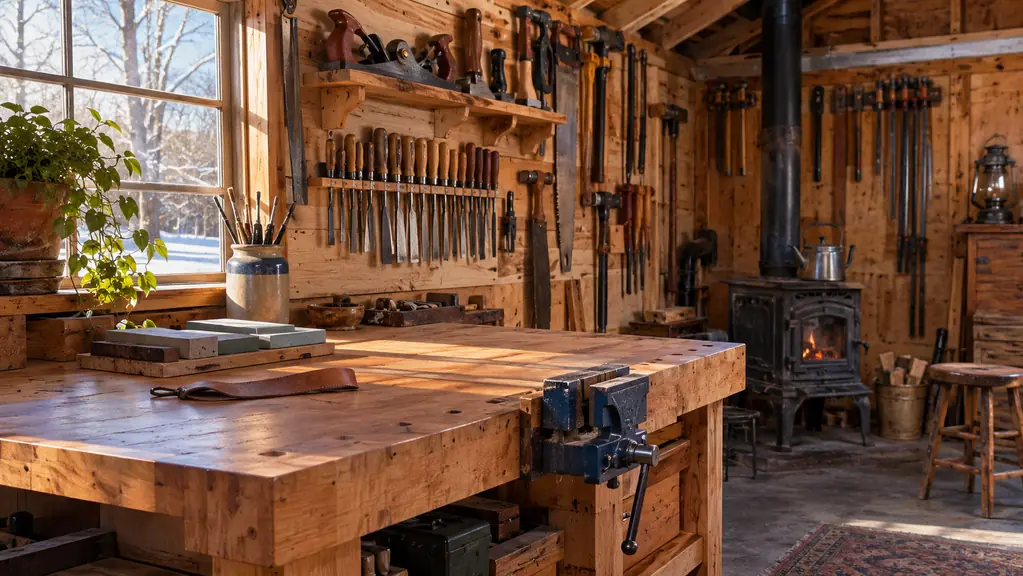
My shop is a single-car garage I converted, with one hard maple bench I built myself, a wood stove in the corner, and the sharpening station under the window because that is where the light is best. The gauge lives in the tool well at the back of the bench, which means it gets picked up and set down fifty times a session. It has been dropped on the concrete twice and once onto the stove hearth, which is worse. Nothing bent. The bar still reads true against an engineer's square, and I checked it because after that second drop I did not believe it would.
The work I do now is mostly furniture and small boxes, plus repairs for neighbors with old houses. That means a lot of layout on stock that is already planed and not cheap to replace, and layout is where a bad line costs you. Setting a mortise a quarter inch in from the face side is the sort of thing you do forty times in an afternoon. With this gauge I set the fence once, check it against a rule, and every line after that is identical because the fence does not creep. That consistency is worth more to me than any single feature on the tool.
One habit I had to build, and it took about a week. The wheel cuts best when you pull the gauge toward you in two or three light strokes with barely any downward pressure. If you lean on it the way you leaned on a pin gauge, the wheel digs in and the fence lifts off the face, and the line wanders off parallel. That is not a defect in the tool. It is a change in how you use it, and once the change sets in you will not go back, because the light pass is faster and cleaner than the heavy one ever was.
The Graduated Bar Is the Point
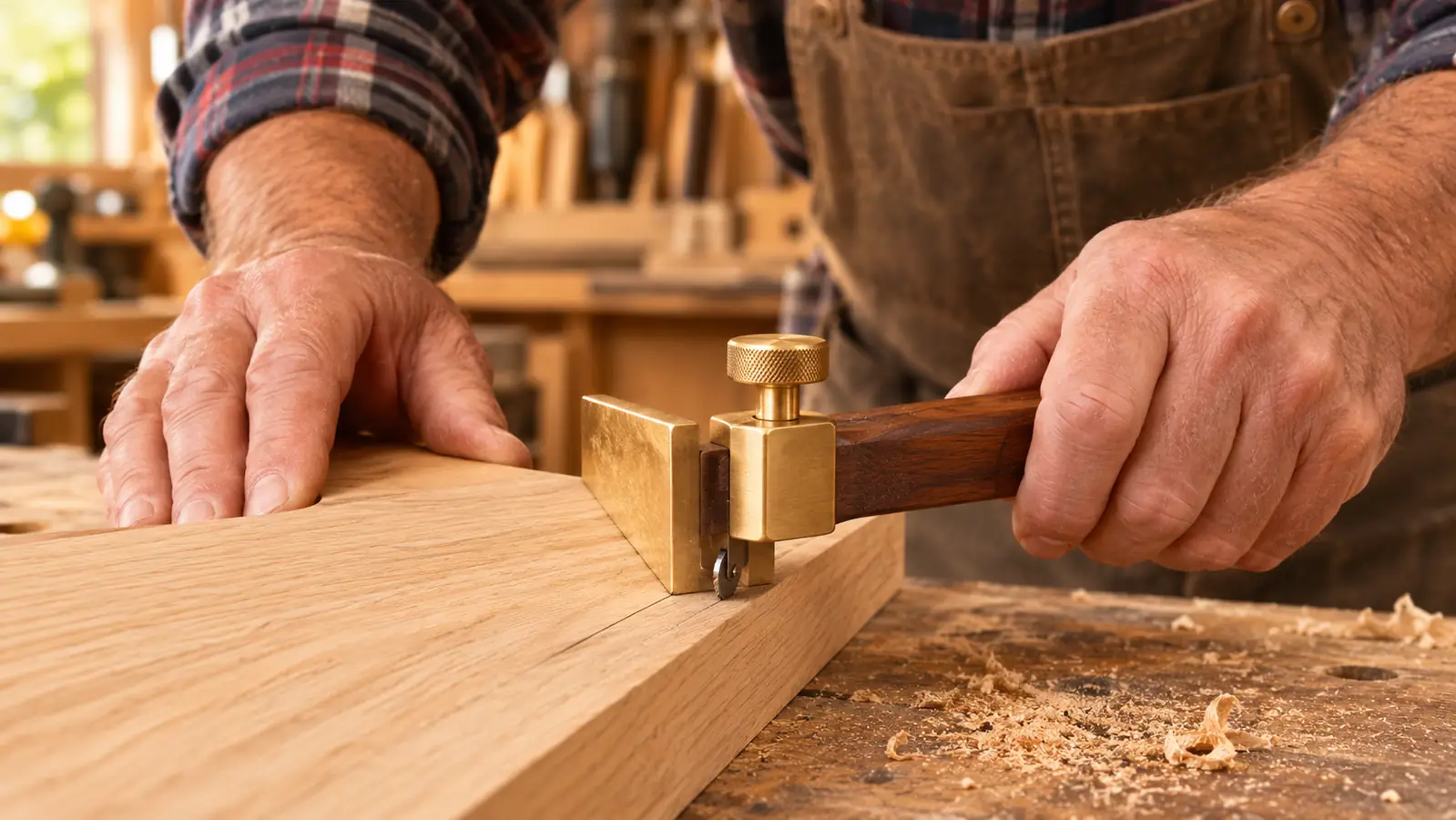
The bar is 8 inches long and laser engraved with graduations in both metric and imperial, marked up to 6 inches and 150 mm. Plenty of wheel gauges have no markings at all, and with those you reach for a rule every single time you change a setting. Having the scale on the bar means I set the fence, glance at the number, and know where I am without hunting through shavings for a rule. The engraving is cut into the steel rather than printed on it, so it reads clearly in shop light and does not wear away where your thumb sits.
In practice I use the first two inches for most joinery and the far end for wider setbacks, like the half inch shoulder on a box lid or the reveal on a face frame. The imperial side is divided fine enough for the work I do, and the metric edge is there if you work that way. I have not yet run into a setting the bar could not give me, including the odd one and a half inch spacing on the drawer sides, which I set once and then repeated thirty-nine times without thinking about it.
An honest note about graduations, because I have seen them oversold. A scale engraved on a bar is a convenience, not a precision instrument, and I still check the fence against a steel rule when a joint has to fit the first time with no room to sneak up on it. The scale gets me close in a hurry and it keeps me consistent across a batch. It does not replace the rule for the one cut that matters.
The Roll Stop Fence and the Flat Spot
The feature Clarke Brothers makes the most noise about is the fence, and for once the noise is justified. The fence is round like most, but it has a flat spot machined into it and a small shoulder they call a roll stop. What that means at the bench is simple. You can set the gauge down and it does not roll off onto the floor. And when you run it along a face, the flat registers against the wood instead of the whole tool pivoting on a single tangent point. A round fence on a round bar wants to rotate. The flat spot stops it.
The way that shows up in the work is a line that stays parallel to the edge. I test a gauge the way I test anything, by marking a line, flipping the stock end for end, and marking from the opposite edge to see whether the two lines meet. They have met every time. I owned a cheap gauge years ago where the fence crept a few thousandths over a dozen strokes and the last line in a run was off far enough to see against the first. I have not had that happen here, and I have looked for it.
The tool is about 2 inches across at the body and 8 inches long, which is small enough to sit in an apron pocket. It weighs 0.17 kg, so a shade under six ounces. That sounds like a detail until you are holding it at the end of a long day, marking the underside of a carcase lying on its back, working one-handed with your shoulder against the bench. Weight you never notice at nine in the morning is weight you resent at four.
Forty drawer sides, one fence setting, and the last line was the same as the first.
The Cutters, the Brass, and What Shows Wear
The body is solid brass with steel and aluminum alloy parts, and brass was the right choice for a tool that gets handled this much. It does not rust in a garage that swings between a hot wood stove in January and damp air in April. The knurled surface gives you something to grip when you are resetting the fence with sawdust on your hands, though the knurling is also where the brass shows its age. After eight months the high spots on mine have gone smooth and darker. That is cosmetic. It has done nothing to accuracy that I can measure.
Two extra hardened steel wheel cutters come in the box, and that is the detail I did not appreciate until I looked at the edge under a loupe. A wheel cutter is a bevel ground on a disc. It dulls the way any edge dulls, just more slowly because you are only cutting a few thousandths deep. When it goes dull the line changes from a slice to a scratch, and you feel it in the pull before you see it on the wood. Having spares means you can change one mid-project instead of finishing the job with a bad line and ordering later.
The first cutter lasted through the boxes, the barn door joinery, and most of the drawer sides before it needed attention. I hone it flat on a fine stone, the same motion I use on a chisel, and it takes about a minute. That is the whole maintenance routine. No oil, no parts to lose, nothing to adjust. I have not had a cutter loosen in the body, and I have not chipped one, including on the drop onto the hearth that I would rather not talk about further.
What It Will Not Do
It will not cut a heavy line deep enough to register a saw. A wheel gauge is a layout tool, and for a cut you care about you still want a marking knife to establish a wall for the saw to run against. It also will not do the job of a mortise gauge with two pins set to both sides of a mortise at once. This is a single point gauge. For most furniture work one line at a time is all I need, and when I need two I set it twice, which takes four seconds.
It also will not forgive a cupped board. If the face you are registering the fence against is not flat, the fence follows the cup and the line follows the fence, and the joint comes out tight on one end and open on the other. That is true of every gauge ever made and worth saying anyway, because the tool is the thing that gets blamed for it.
What I Liked
- Graduated bar in metric and imperial, readable with shavings on the bench
- Flat spot on the fence keeps the line parallel and stops the tool rolling off the bench
- Holds its setting through a whole batch of parts
- Two spare hardened steel cutters included
- Solid brass body that shrugs off a damp New Hampshire garage
Where It Falls Short
- Knurling goes smooth and dark with handling
- Wheel needs a light pass, and old pin gauge habits produce a wandering line
- Single point only, so no mortise layout without resetting
- The scale is a convenience, not a substitute for a rule on a critical joint
Who This Is For
If you cut joinery by hand, even occasionally, this belongs on the bench. It is the tool that turns a pencil line into something a chisel can register against, and the graduated bar saves you reaching for a rule every time a setting changes. Hobby woodworkers building a few pieces a year get the most obvious benefit, because this removes one entire category of error from their layout before they ever pick up a chisel.
It also suits anyone coming back to hand tools after years away, or anyone who learned on a pin gauge and never once got a clean line out of it. The learning curve is about a week of lighter passes. After that it is faster than what you were doing before, and your joints will show it.
Who Should Skip It
If you only break down sheet goods and cut to a line with a circular saw, a marking gauge is not going to change your day, and I would not spend the money on my say so. And if you already own a good wheel gauge that holds its setting, this one is not different enough in kind to justify a second. The graduations and the flat spot are real improvements. They are not a new category of tool.
The other person who should think twice is anyone expecting one gauge to do the work of a mortise gauge or a cutting gauge. This is one tool doing one job well, and it earns its place in the tool well on that basis alone. Buy it for laying out single lines against a face, and it will be the gauge you reach for first every time.
One setting, forty identical lines
Solid brass body, 8 inch bar graduated in metric and imperial, roll stop fence, two spare hardened cutters. If layout is where your joints go wrong, this is the first place to fix it.
Amazon Check Today's Price on Amazon →