
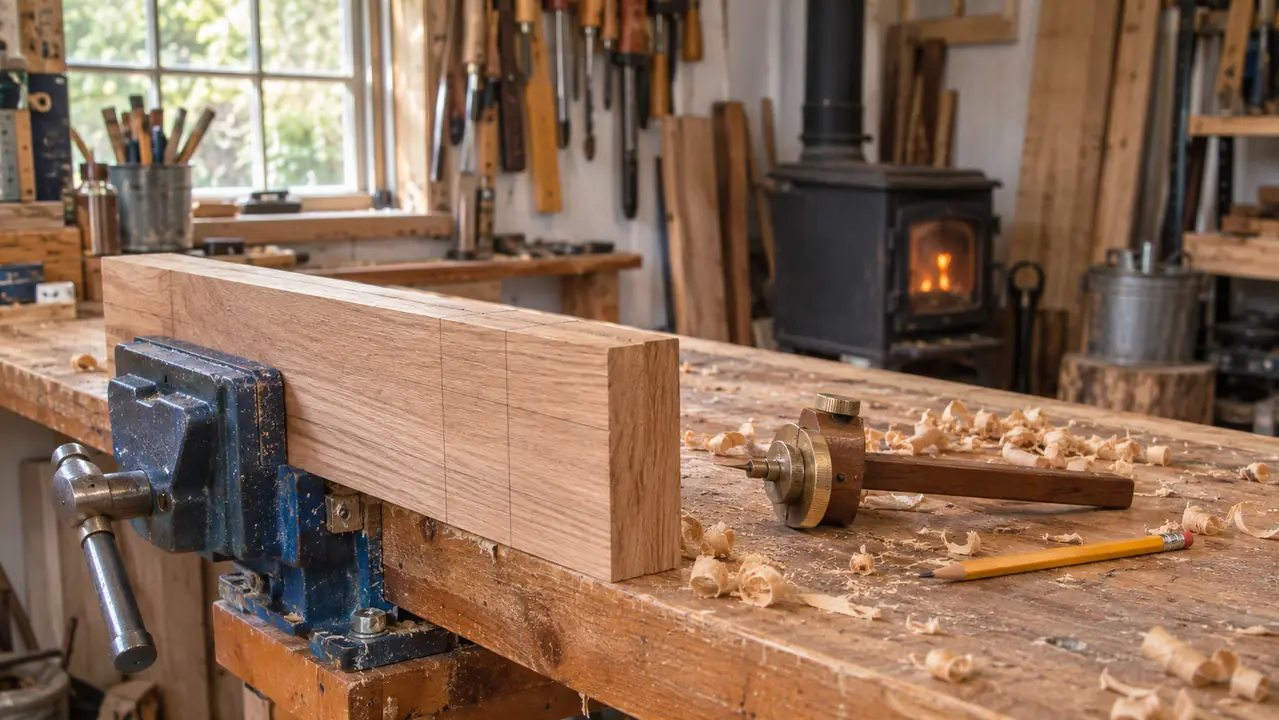
Twenty years of cutting dovetails by hand and I still reach for a pencil more often than any tool on the bench. That is not a confession I make lightly, because I own four marking gauges and there is one I would not give up. So when a reader asks whether a wheel marking gauge is worth the trouble next to a sharp pencil and a good rule, I understand the question. The short answer is that the two do different jobs, and the job you do most often decides which one belongs in your apron. Here is how the Clarke Brothers wheel gauge holds up beside plain pencil layout after a full season of use on my bench.
If you cut the same joint on twenty parts, the gauge wins and it is not close. If you need one line on one board and you need it now, the pencil wins and the gauge is a waste of your time. The Clarke Brothers is a wheel gauge: a hardened steel cutter on the end of an eight inch bar, a fence that rides the reference face, and a body of solid brass, steel and aluminum alloy. It weighs 0.17 kg. It is ambidextrous, so it does not care which hand you use. And it cuts a line rather than drawing one, which is the whole difference.
| Clarke Brothers Wheel Marking Gauge | Pencil and Rule | |
|---|---|---|
| Setup for a single line | Set the fence to the graduation, mark, done. Fifteen seconds once you know the tool. | Pick up the pencil, step the dimension off a rule, mark. Faster for one line. |
| Part twenty matching part one | The fence stays where you set it, so the last part matches the first. | Every mark is a fresh judgement with a rule in between, so small drift creeps in. |
| Line at the saw kerf | The wheel cutter slices the fibers and leaves a shoulder the saw can sit against. | Graphite has width and it smudges, so the saw can wander inside the line. |
| Setting a dimension | Laser engraved graduations on the bar, metric and imperial, up to 6 inches or 150 mm. | Needs a separate rule and a steady eye on every mark. |
| Freehand curves and odd shapes | Not the job. The fence wants a straight face to ride against. | A pencil follows any line your hand can draw. |
| Rough or weathered stock | A fine sliced line disappears into torn grain. | A soft pencil still reads on grey, furry boards. |
| Inside a stopped cut or a tight corner | The fence needs room to sit flat against a reference face. | A pencil reaches where the fence cannot follow. |
| Keeping it running | Two spare hardened steel cutters ship in the box, so a dull wheel is a swap, not a purchase. | Pencils get sharpened away, snapped and lost. You buy them forever. |
| Learning curve | About an hour of scrap-wood practice before the line lands where you meant. | You have been doing this since grade school. |
| Weight in the apron | 0.17 kg of brass and alloy riding on your hip all day. | Almost nothing. |
Where the Clarke Brothers Gauge Wins
Start with the batch, because that is where the argument is settled. Last winter I built six small boxes from one board of cherry, nine inches long and five wide, and every one of them needed a groove three eighths of an inch up from the bottom edge. That is twelve parts once the ends are cut in pairs, and twelve is the number that matters. With a pencil I would have stepped that dimension off twelve separate times, and by the fourth box my eye would have drifted. With the Clarke Brothers gauge I set the fence against the graduation once, and the fence held for the whole run. When I dry fitted them, every groove lined up without a touch of the file. There is also a flat spot machined into the fence so the tool does not roll off the bench between parts, which sounds like a small thing until you have chased a round brass tool across a concrete floor.
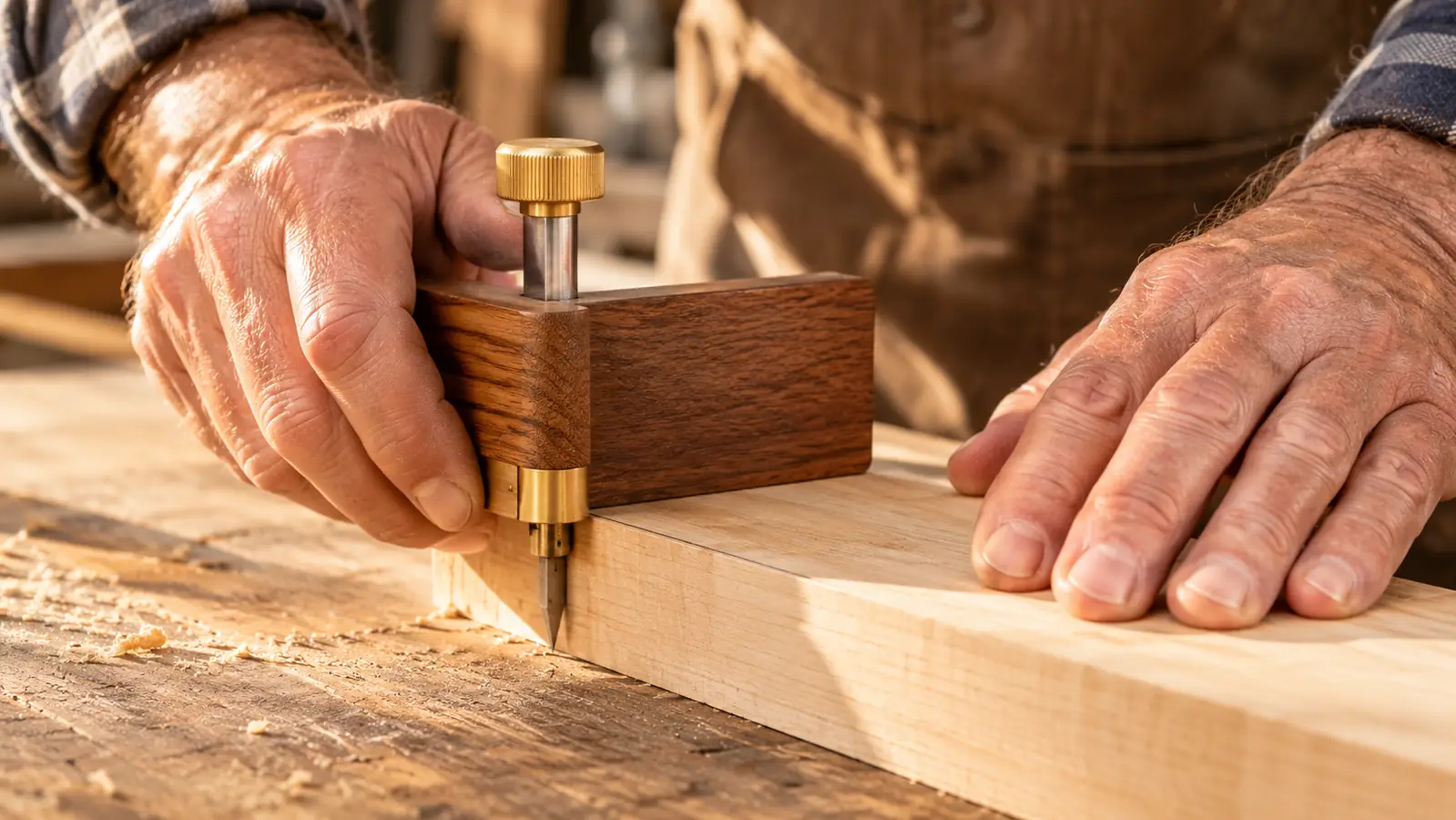
The second reason is what the line looks like. A wheel gauge does not draw, it cuts. The hardened steel wheel stands on edge and slices the surface fibers, so what you get is a fine slit with a small shoulder on one side. A saw started in that shoulder has nowhere to wander. A pencil line, honest as it is, has width, and width is exactly what a dovetail saw will find on the day you are not paying attention. For a joint that will show, I want the slit.
Then there is the setting itself. The bar carries laser engraved graduations in both metric and imperial up to 6 inches or 150 mm, so I set the fence by reading the bar instead of hunting for a rule and hoping the fence did not shift while I did it. The tool is eight inches long overall, so there is bar past the graduations to hold, which suits my hand better than a shorter gauge ever did. The grip is knurled and the tool is ambidextrous, which matters more than it sounds. I mark left handed at one end of the bench and right handed at the other, depending on which side the vise is clear. A tool that only worked one way would have me walking around the bench all afternoon.
One of the two spare hardened steel cutters lives in the drawer and the other in the tin with my sharpening stones, and after a season of steady use I have not needed either. That is worth saying plainly, because a dull wheel is the usual complaint about gauges of this kind, and having a spare in the box turns a spoiled afternoon into a two minute swap. When the day comes, I will not be ordering anything and waiting a week to finish a job.
The saw started in the slit and stayed there for all six boxes.
Where the Pencil Wins
Now the other side, because a pencil is not the enemy. If I need one line on one board, the pencil is finished before the gauge is out of the drawer. Two weeks ago I broke down a walnut plank for a small table top and used the pencil for every mark on it, including the crown direction, the face I wanted showing, and which end to crosscut first. The gauge never came out for that job and it should not have. Breaking a board down to rough length, marking which end is up, scribbling a note about grain direction so I do not plane the wrong way, all of that is pencil work and always will be. Freehand curves too. A gauge with a fence is built to reference a straight, true face. Ask it to follow a fair curve for a bracket foot and it will simply refuse, correctly.
Rough or weathered stock is the other place the pencil holds its ground. I still take on repair work for neighbors with old houses, and the boards that come out of those walls are grey, furry and full of grit. One sill I pulled last spring had eighty years of dirt worked into the end grain, and I marked the cut with a carpenter's pencil held flat, because anything finer would have been swallowed whole. A fine sliced line vanishes into grain like that. Same story inside a stopped cut or a tight corner where the fence has no flat face to sit on. A pencil reaches in there. A fence cannot.
And there is the plain matter of upkeep. A pencil lives in your apron and when it snaps you sharpen it on the spot. The gauge is a tool you buy once and keep, with two spare hardened steel cutters in the box for the day the wheel dulls, but it is still a purchase and it still wants a home on the bench where you can find it. Nobody should feel badly about reaching for the pencil. I do it constantly, and I have no plans to stop.
When the same joint has to come out right twenty times
The Clarke Brothers wheel gauge holds its setting across a whole batch and leaves a slit the saw can follow. Graduations in metric and imperial up to 6 inches, ambidextrous grip, and two spare hardened steel cutters in the box.
Amazon Check Today's Price on Amazon →How the Two Work Together on My Bench
In practice I do not choose between them. I use them in a fixed order. The pencil comes out first, for the rough breakdown and for marking the face and edge I intend to keep true, because the gauge needs a reference face and I need to tell myself which one it is before I start cutting. Then the gauge takes over for every dimension line that has to relate to that face. Pencil for thinking, gauge for measuring. That is the split, and it has not let me down yet.
The reason the split works is that a gauge does not measure from an edge in the abstract. It measures from the face you press the fence against, and nothing else. That is a limitation and a gift at the same time. It means the tool ignores the far edge, so a board that is a thirty-second out of square still gets an accurate line. A pencil and rule would carry that error straight across the part. Once you understand it, you stop fighting the tool and start using it properly.
The one habit worth building is to sort the parts first and do every mark that shares a dimension in a single sitting. Set the fence once, mark all of them, put the gauge down. It feels slower to stack and sort before you mark anything. It is not. Last month I cut four drawer sides and could have marked them one at a time as each came off the saw. Instead I stacked them, set the fence once for the groove line and once for the shoulder line, and had all four marked in the time it used to take me to mark two. That habit plus a sharp pencil is most of what layout comes down to.
What I Liked
- Fence stays set across a whole batch of parts
- Cutter leaves a shoulder the saw can start in
- Graduations on the bar in metric and imperial up to 6 inches
- Two spare hardened steel cutters included
- Ambidextrous, so it works in either hand
Where It Falls Short
- Needs a straight reference face to ride against
- Takes practice before the line lands where you meant
- A fine line vanishes on rough or weathered stock
- Adds weight to an apron pocket next to a pencil
The Mistake I Made First
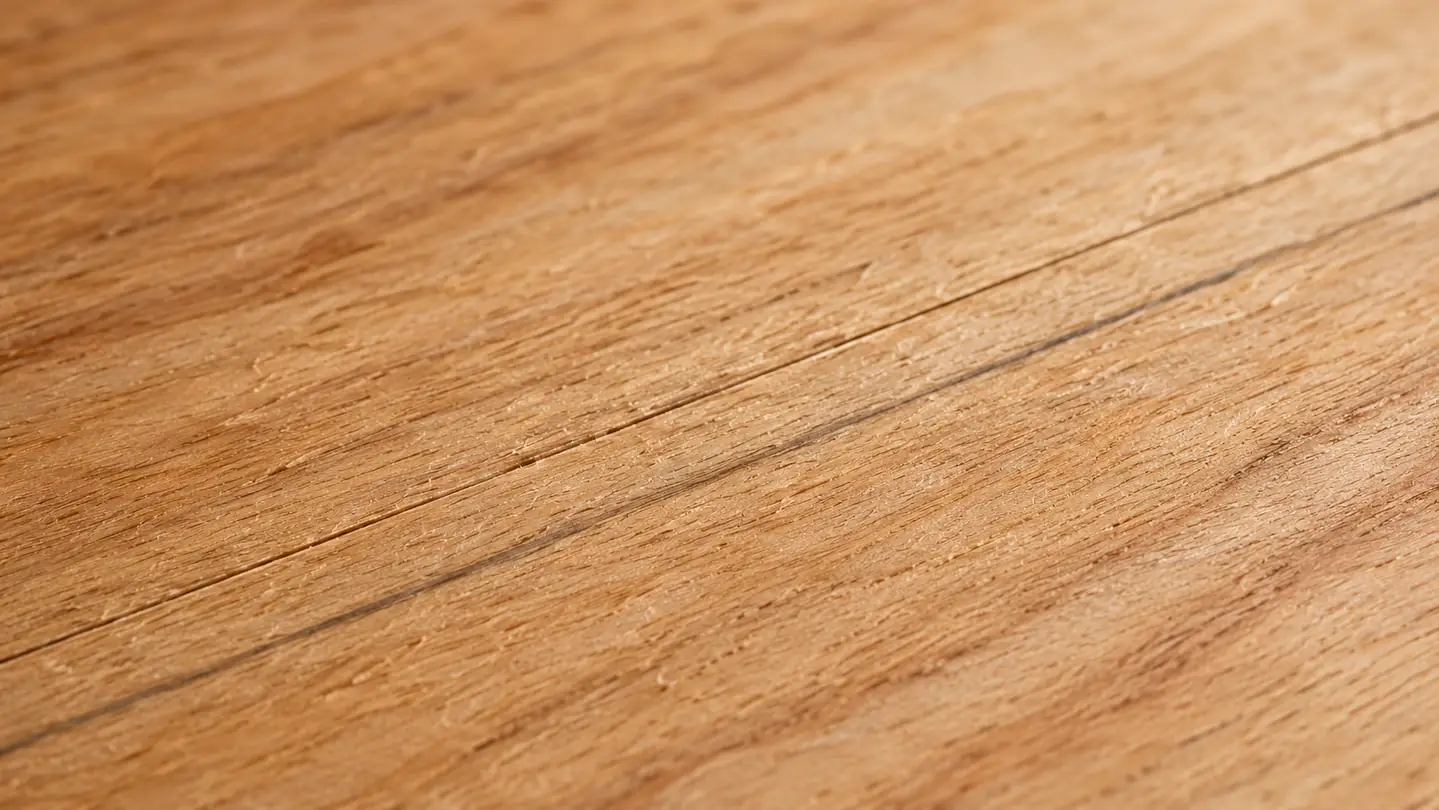
My first week with a wheel gauge was a mess, and I know exactly why. I was pushing down as though the cutter needed force to cut. It does not. A wheel cutter wants the tool held lightly and drawn along the face, with the fence flat against the reference and the bar level. Press hard and the wheel digs in, the fence lifts off the face, and the line wanders. I spoiled two pieces of maple I had set aside for a small chest before I worked that out, and one of them is still in the scrap bin as a reminder. The line on that piece starts true and then bows toward the edge about three inches along, which is precisely the moment I started leaning on it.
The other half of the mistake was tilting the tool. If the bar is not level, the cutter rides the corner of the board instead of the face, and you get a line that is neither on the face nor on the edge, which is worse than no line at all because you will saw to it anyway. Level, light, and a straight reference. That is the whole technique, and it takes about an hour on scrap to make it automatic. I spent that hour on poplar offcuts, marking against the rule and checking every line with a square, and I would recommend the same to anyone picking one up for the first time.
Who Should Buy Which
Buy the Clarke Brothers gauge if you build in multiples or cut joinery that has to close. A set of drawers, a run of boxes, six chairs, a bookcase with twelve identical shelves. Any job where a dimension repeats is a job where the gauge pays for itself in fewer scrapped parts and less checking. If you are working toward hand-cut dovetails or a mortise and tenon, this is the tool that puts the line where the saw needs it.
Stay with the pencil if your work is one-off, if you are still finding out whether you enjoy hand tools at all, or if most of what you mark is rough stock and repair work. There is no shame in it and no accuracy penalty that matters for a birdhouse or a shelf bracket. A pencil and a decent 6 inch rule will cover most of what a beginner needs, and the gauge will still be here when the work gets fussier.
Most people reading this, I suspect, are in the third group. They own a pencil, they cut a fair amount by hand, and they are tired of checking the same dimension twice. That is exactly the case for the gauge. Mine has not left the bench since the day I set it up, and I reach for it now without thinking about it, which is the surest sign a tool has earned its place.
Set the fence once and mark the whole stack
Solid brass, steel and aluminum alloy body, 8 inch graduated bar, ambidextrous grip. Two spare hardened steel cutters included, so a dull wheel is a swap and not a purchase.
Amazon Check Today's Price on Amazon →