
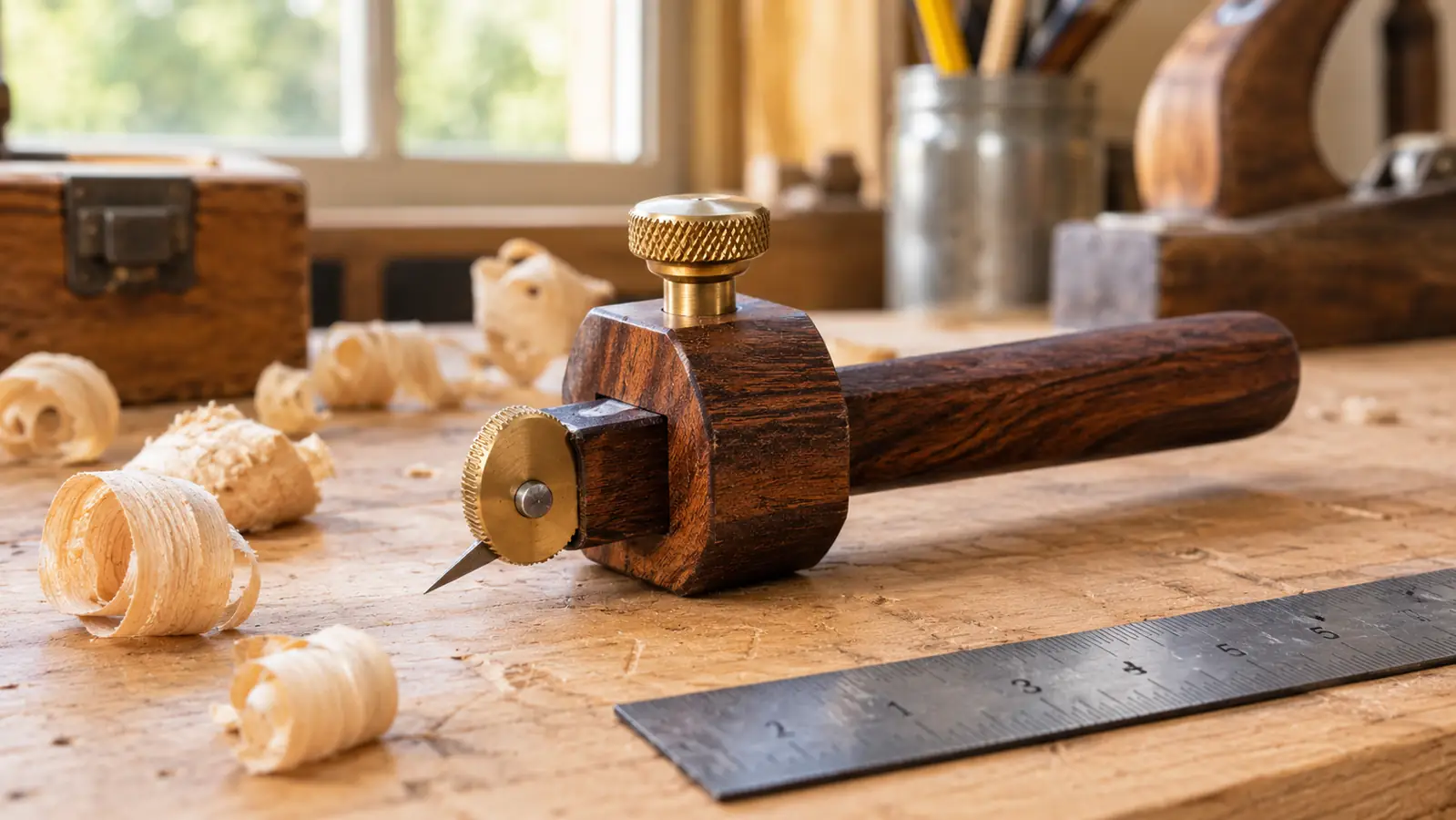
Every marking tool I own has one job, and most of them do it badly. A pencil line is a suggestion. By the time you saw to it the line has width, and you have a joint that gaps. A pin gauge does better until you cross the grain, and then the pin follows the soft wood instead of the straightedge and your shoulder ends up crooked. I marked joinery with a pin for most of thirty years and sharpened that pin more times than I can count. The Clarke Brothers Wheel Marking Gauge swaps the point for a small hardened steel wheel, and that one change fixed most of what annoyed me.
What follows is not a list of features off the box. It is ten things I noticed working with it on real parts: drawer sides, mortises in white oak, a set of sash repairs for a neighbor. If you already own a pin gauge and think it is fine, reason three is the one to read.
A line thin enough to put a saw tooth against
Solid brass body, an 8 inch bar graduated in metric and imperial, and two spare hardened steel cutters in the box. Check today's price on Amazon and set the fence once.
Amazon Check Today's Price on Amazon →A wheel cuts the fibers instead of shoving them aside
A marking pin is a tiny wedge. Drag it across a board and it has to go somewhere, so it dives into the soft summer wood and rides up on the hard winter bands. That is why a pin line looks like a dotted scar on oak and wanders on pine. The cutter here is a small disc of hardened steel with a bevel ground to the rim. It severs fibers in a single pass. The line comes up shallow and clean, roughly the width of a knife kerf, which means a pencil sits in it without wobbling.
Cross-grain work stops tearing out
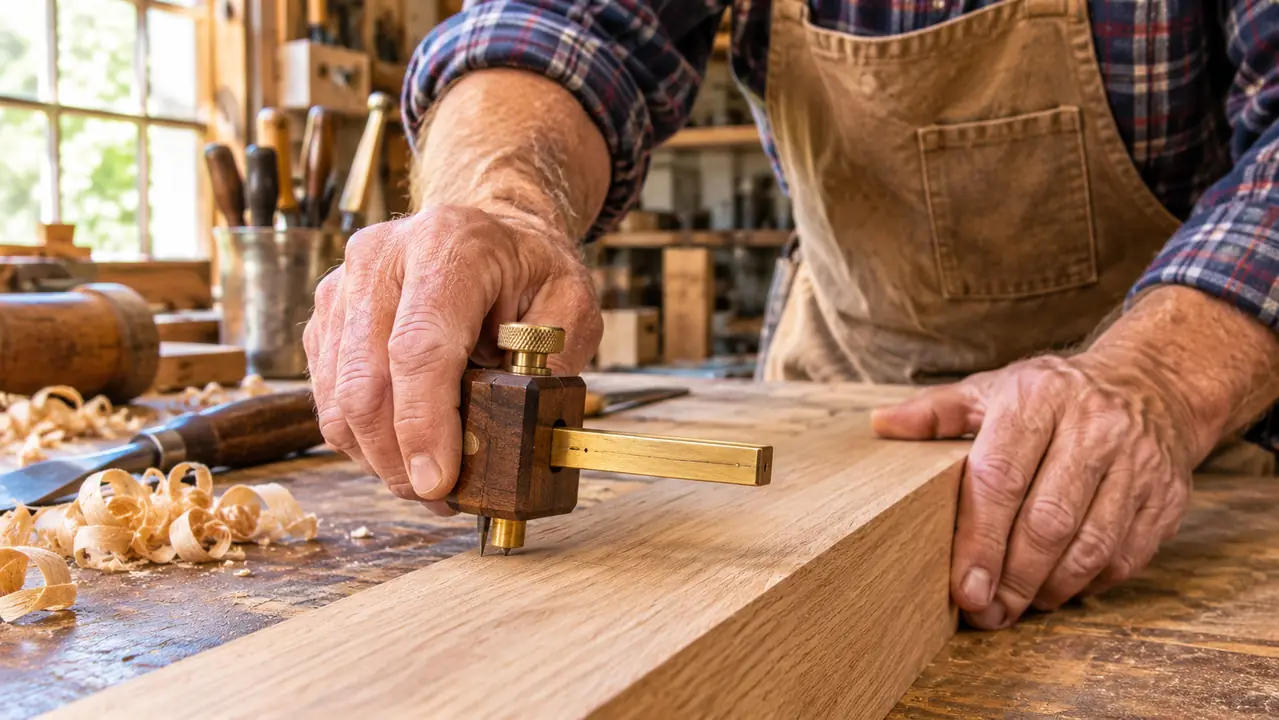
Mark a tenon shoulder across the grain with a pin and you will lift fibers. Every time. On something soft like eastern white pine it can tear a shallow groove you then have to plane away, and once you plane it, the shoulder has moved. The wheel does the opposite on the same wood with the same pressure. I noticed it first on old sash stock, brittle and dry, where the wheel line was the only mark that did not raise a burr.
The fence has a flat spot, so it stays where you put it
A round fence feels right in the hand and has one flaw. Roll it along an edge and it wants to keep rolling, so the line drifts and you do not notice until the joint is cut. Clarke Brothers machines a flat spot on the fence, what they call a roll stop. Sit that flat against the edge and the gauge registers and holds. It is a small thing to look at and the difference between marking twice and marking once.
Set it once and mark the whole run
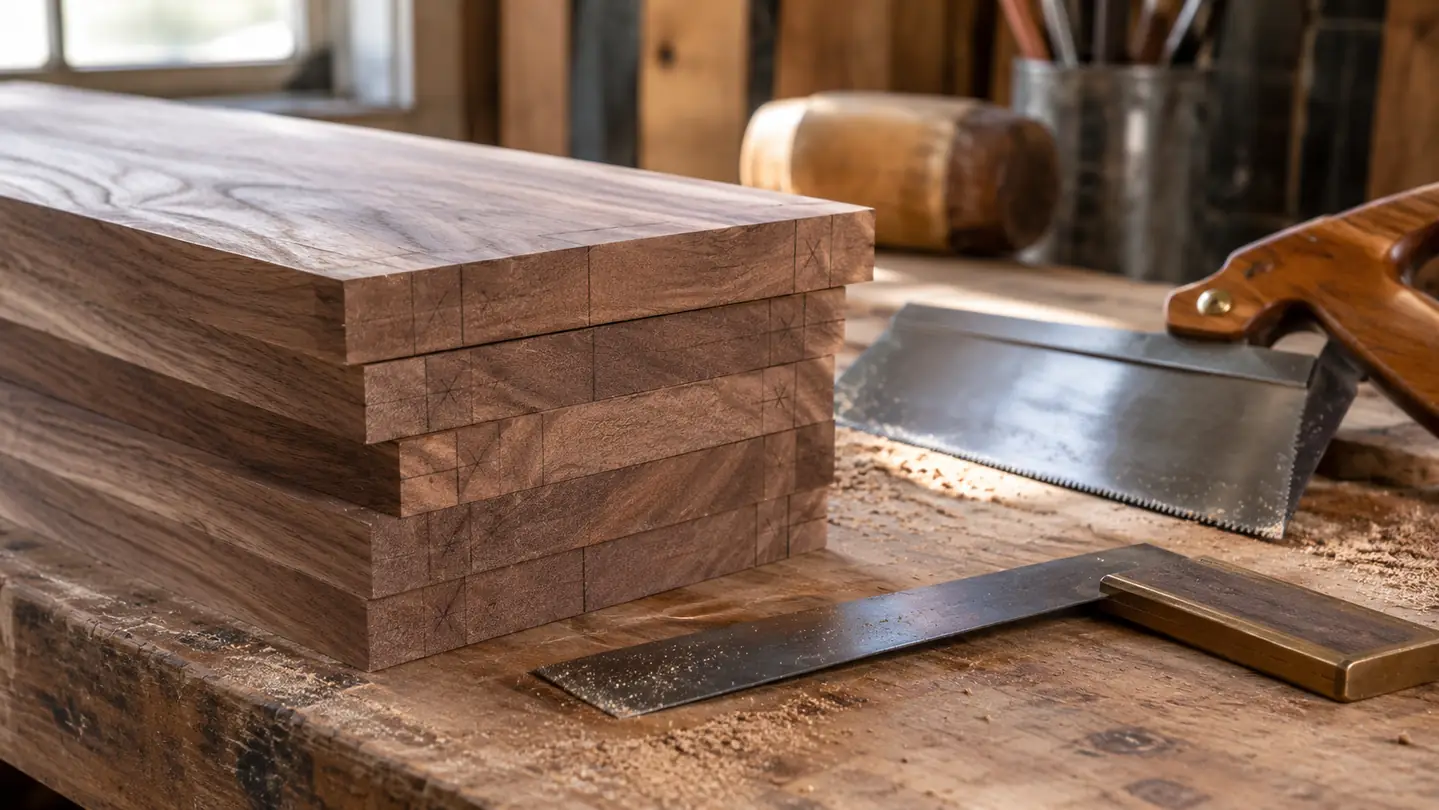
Most marking is not one part, it is twelve of the same part. With a pin you tap, check, tap, check. With this you set the bar against a rule, tighten, then run down every piece in the stack. Twelve drawer sides, one setting, one line height, no variance. When you cut dovetails by hand a consistent baseline is not a nicety. It is the thing that lets the pins fit without paring.
The graduations are on the bar, so the rule can stay in the drawer
The bar is laser engraved in both metric and imperial, numbered up to 6 in and 150 mm. That is no substitute for a steel rule when you need real precision, but for setting a shoulder 3/8 in from a face, or a rabbet at 10 mm, it beats hunting for the rule under the shavings. The marks are cut into the metal rather than printed, so they do not wear off under your thumb.
The brass body has enough weight to sit still
Solid brass, with steel and aluminum alloy in the wear points. It measures 8 inches long overall, 2 by 2 by 8 inches, and 0.17 kg on the scale. That weight is the point. A light gauge skates across the board and you end up clamping down on it, which throws your line depth all over. This one sits flat and lets you push with two fingers.
Two spare cutters come in the box
You get two replacement hardened steel wheel cutters with the gauge. I have not needed one yet, but a wheel edge is thin and a drop onto a concrete floor is how they usually go. Two spares mean you are not ordering a part and losing a week. When a cutter does begin to dull it will skate more than it cuts, and you will feel that before you see it in the line.
It works in either hand
Knurled grip, ambidextrous body. I am right handed, but I mark left handed when a board is clamped with the face toward me, and this gauge does not care. Nothing on it is handed. No thumb rest on one side only, no lever that wants a particular finger. Plenty of gauges get that wrong and you find out the first time you reach across the bench.
It disappears into an apron pocket
8 inches long and 0.17 kg. It drops into a pocket and you forget it is there until you need it. That sounds trivial and is not. The tool you actually use is the one already in your hand, not the one behind the plane till. My shop is a single garage, and I still lose things in it. Anything that lives in a pocket earns its keep.
A real line teaches you to saw to the waste side
The last reason is not about the tool. When your line is a fat pencil smudge you cannot tell which side of it the saw tooth is on, so you split the line and clean up the mess with a chisel. A wheel line is thin enough to place a tooth against. That lets you saw on the waste side and leave the line standing, which is the whole discipline of hand work. The gauge does not make you careful. It makes carefulness possible.
A pencil line is a suggestion. A wheel line is a place to put the saw.
What I'd Skip
I would skip the boxed set of five gauges. You need one good wheel gauge far more than five mediocre ones, and the money is better spent on a diamond plate for the sharpening station. I would skip a carpenter's pencil anywhere near a joint. And I would stop using a pin gauge for cross-grain joinery altogether, keeping the pin for rough layout on framing and letting the wheel do the parts that show. Two honest limits on this one. The graduations stop at 6 in and 150 mm, so for anything wider the tape comes out. And the thin cutter rewards you for keeping the fence clean. A speck of grit under the fence throws a line off by a hair, and a hair shows in a dovetail. Wipe the fence, check the flat spot is against the edge, then mark.
Set the fence once, then mark the whole stack
The Clarke Brothers Wheel Marking Gauge comes with two spare hardened steel cutters and a bar graduated in metric and imperial. Check today's price on Amazon before you start the next run of parts.
Amazon Check Today's Price on Amazon →