
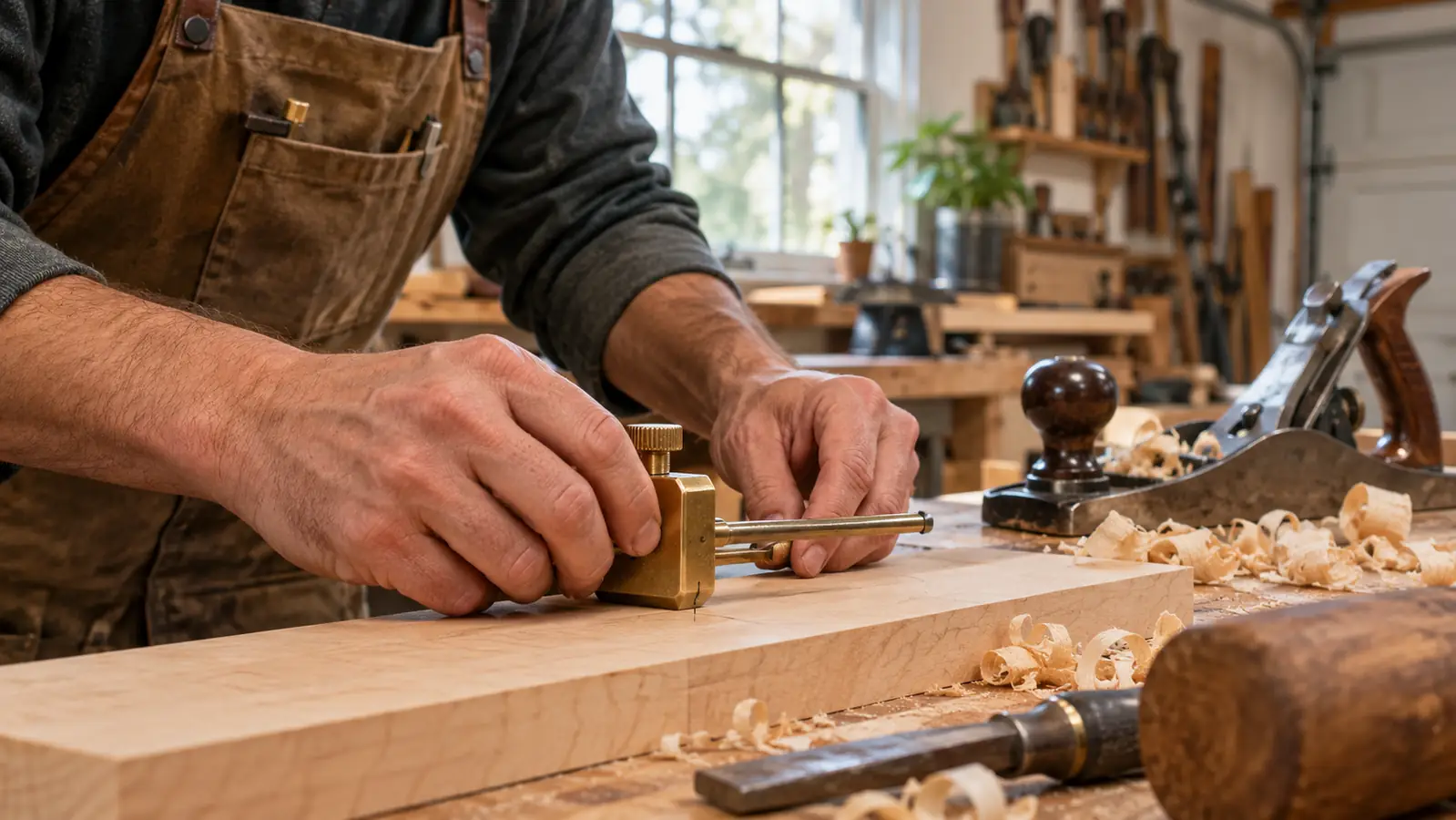
The Clarke Brothers wheel marking gauge arrived in a plain cardboard sleeve, and my first reaction was that it felt too light in the hand to amount to much. That reaction was thirty years of habit talking. I learned to cut joinery with a pin gauge, a steel bar and a beech head that had been worn into a comfortable shape by somebody else's hands before it ever got to mine, and I have been suspicious of anything that shows up with a marketing story attached ever since. So treat this as the review I wish somebody had handed me before I spent an evening reading product pages instead of working.
Here is the part the listings leave out. A wheel marking gauge does not replace a pencil and a steel rule, and it will not rescue a bad layout. What it does better than any other tool I own is carry one setting around a corner and onto a reference face without wandering, which matters more than anything else once you start cutting to a line instead of near one. The Clarke Brothers gauge earns its place in my apron on that single job. It has also irritated me in a few small ways that I will get to, because a review that only lists the good parts is not a review, it is a catalogue.
The Quick Verdict
A genuinely useful wheel gauge for anyone who cuts joinery by hand, held back from a higher mark by graduations that are a reference rather than a stop and a fence you have to set by feel.
Amazon Check Today's Price →Stop fighting a pin gauge that follows the grain instead of your setting
The Clarke Brothers wheel gauge slices the fibres instead of tearing them, and the flat spot on the fence keeps your setting where you left it. Check today's price and the current cutter bundle on Amazon.
Amazon Check Today's Price on Amazon →What the Hype Gets Wrong
Wheel gauges have built a reputation for leaving a clean line with no tear-out, and that reputation is only half earned. A wheel cutter is a tiny disc of hardened steel with a bevel ground on one face. It works by slicing across the wood fibres, so on cross grain and on end grain you get a fine, clean line where a pin would lift and tear the surface. On long grain, especially softwood with wide earlywood, the wheel can burnish the surface instead of cutting it if you press hard. The tool rewards a light hand. Almost nobody says that in the listing, and it is the first thing I had to learn the hard way.
The second thing the hype gets wrong is the idea that a wheel gauge is more accurate than a pin gauge. It is not more accurate. It is more stable. The cutter has no rake to speak of and no tendency to dive, so once the fence is registered against a true face, the line stays parallel to that face for its whole length. Accuracy still comes from where you set the fence, and you set the fence with your eye and a rule. The gauge holds the number. It does not invent it.
The third thing, and this one matters for a hobbyist deciding what to buy, is that the tool is a specialist. If your work is mostly machine-cut with the occasional hand-fitted joint, a wheel gauge will sit in a drawer. If you are laying out dovetails, mortises, rebates or a line that has to travel around four faces at the same distance from the end, you will reach for it several times an hour and wonder how you managed without it. That is the honest dividing line, and it has nothing to do with how good the tool is.
How I've Used It
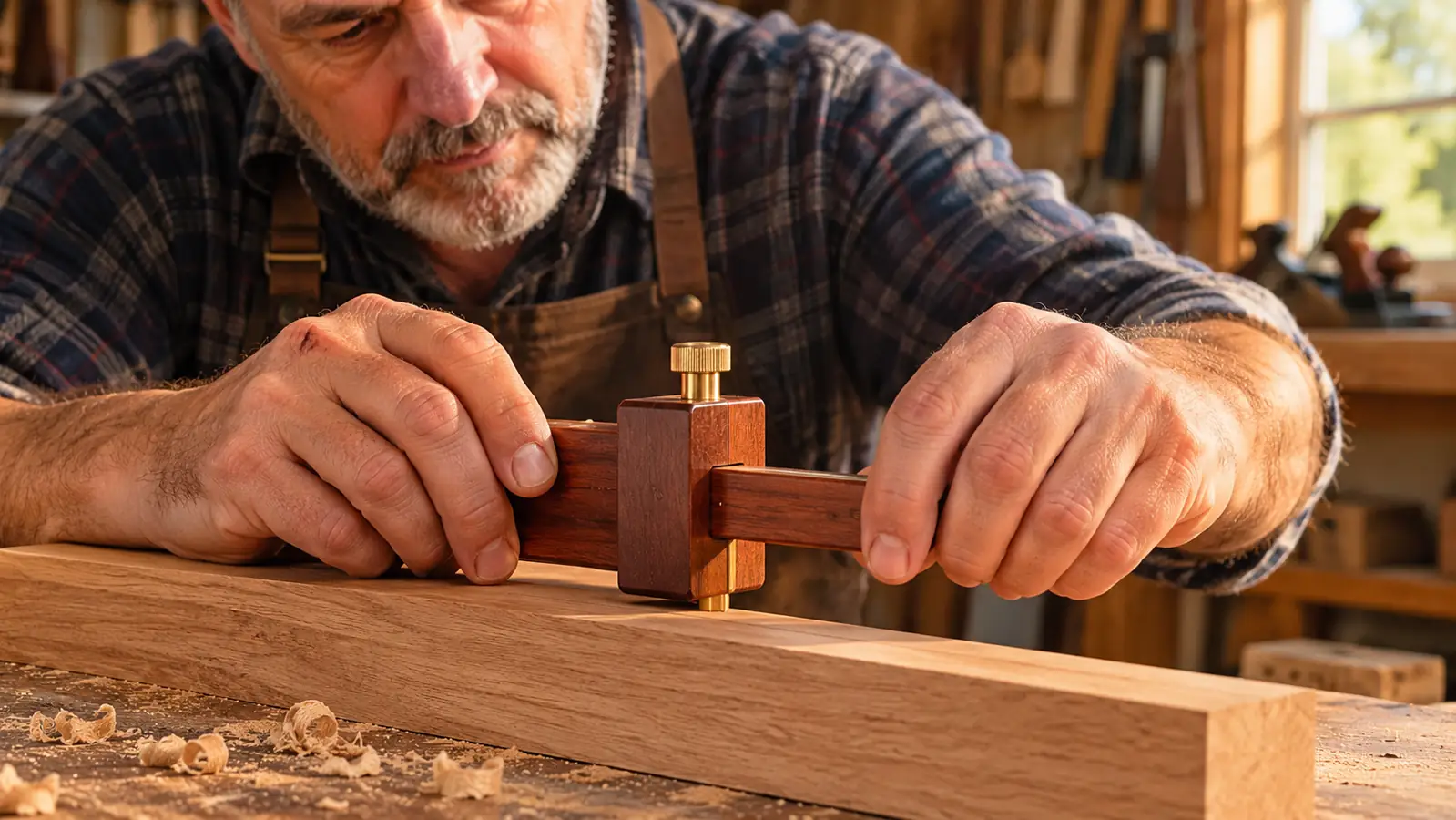
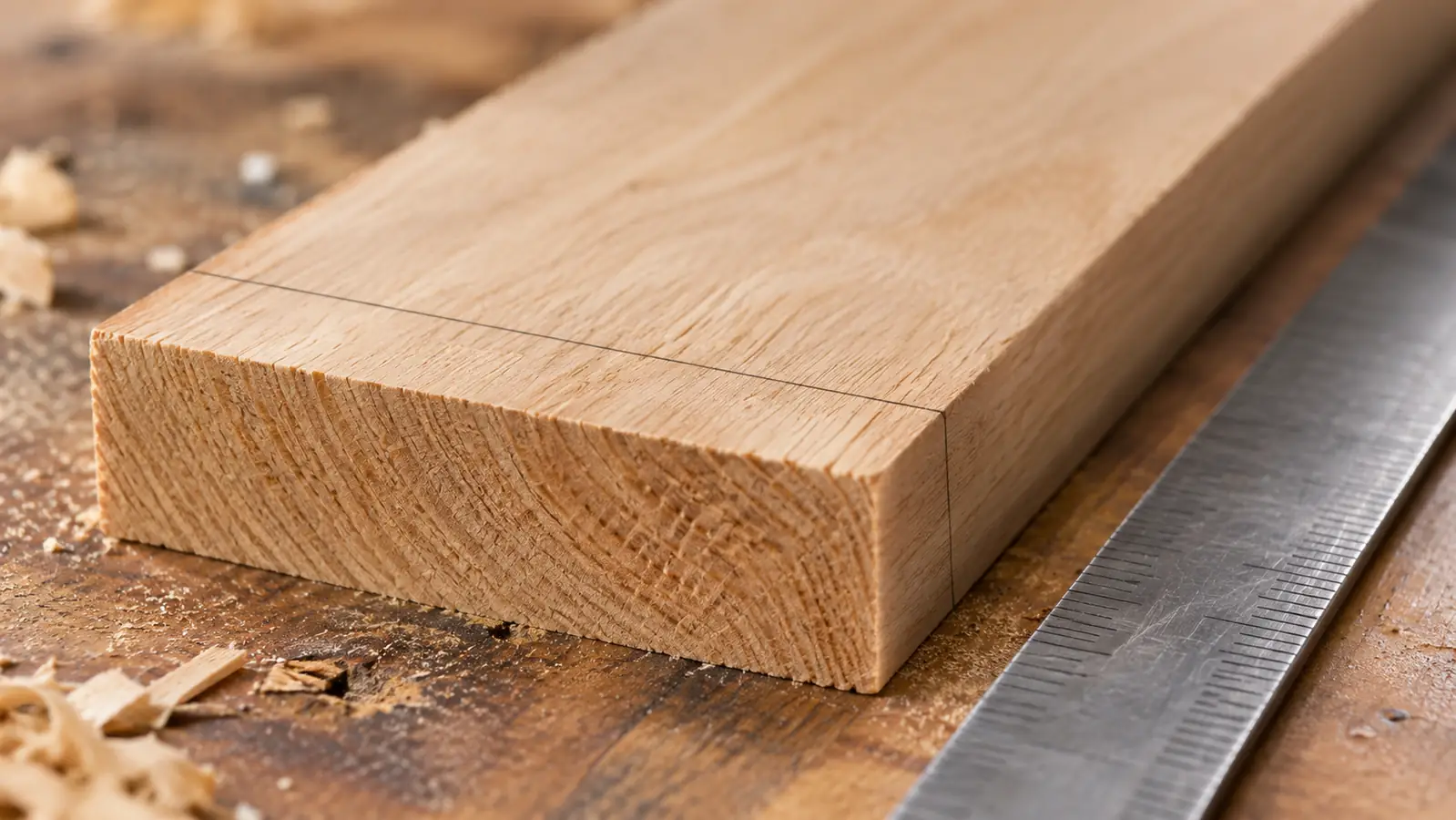
I keep a small walnut box project going in the shop most winters, and this gauge has been in my apron pocket for the last two of them. The job I use it for most is the baseline. On a through dovetail you need a line all the way around four faces at exactly the same distance from the end, and if that line drifts by a thirty-second of an inch on the second face you will discover it when you fit the joint and it will not be a small correction. A pin gauge on walnut wants to follow the grain rather than the setting. I have had a pin run down a soft streak more times than I care to admit. The wheel does not do that, because it is cutting across the fibres rather than pushing between them.
Mortises are the second job. On a small frame or a box, I set the fence once, mark the cheeks on all four legs, and I am done in the time it used to take me to find a pencil. That saving is not about speed so much as it is about errors. Four separate pencil marks are four separate chances to be off. One fence setting is one chance, taken once.
The third job was not one I expected. A neighbor brought over a window sash from a house built around 1890, with a rail that had cracked and been badly repaired once already. I needed a line to work to on a curved, patched, painted surface where a pencil would skid and a pin would wander into the old paint. The wheel scored a fine line through the paint and into the wood underneath, and I could feel the fence riding the edge the whole way. That repair took an afternoon and the gauge did more useful work in it than my chisels did.
The Fence Is the Whole Story
Clarke Brothers calls this a roll stop fence with a flat spot, and the flat spot is the detail worth paying for. On a gauge with a fully round head, setting the tool down on the bench is where your setting goes to die. It rolls, the fence moves against the bar, and you pick it back up with a number in your head that no longer matches the tool. The machined flat on this fence means it sits down and stays put. Two winters in, I have not once had a setting shift because I set the gauge down, and I set tools down constantly.
Setting the fence is a tap and check routine. You slide the head along the bar until the cutter is close, then tap it the last fraction against a steel rule held at the same face, snug it, and check it again. There is no index and no detent. That is normal for a marking gauge and it is not a defect, but it is a real gap between what the product photographs suggest and what the tool does in the hand. If you want a gauge that clicks to a number, this is not that gauge and you should know it before you order.
The other thing the fence does well is register. The head is wide enough and flat enough that it sits against a jointed edge with no rocking, and because the body is round and the grip is knurled, the tool works the same in either hand. I am right handed but I mark left handed on the far side of a board because that is how I was taught to keep the fence against the reference face, and the gauge never once made me feel like I was using it backwards.
The Bar and the Engraved Graduations
The bar runs eight inches, with laser engraved graduations in both metric and imperial reading to six inches or 150 mm. I want to be plain about what those marks are for. They are a fast reference, not a stop. If I need a line at 12 mm I can set the fence against the marks and be close enough for most of what I do. If the line has to be dead on, I check the setting against a steel rule, which takes four seconds and removes all doubt. The graduations have never lied to me, but they have also never promised to be a micrometer.
Where the marks earn their keep is repeatability. Once I find a setting I like for drawer bottoms, I write the number on the jig and I can get back to it weeks later without hunting through offcuts to find the one I used as a spacer. Since the bar is aluminum alloy and the body is brass, the engraving is not going anywhere and neither is the surface. The whole assembly is described as corrosion resistant, and in a shop with a wood stove and a New Hampshire winter, that claim has held up. There is no rust bloom anywhere on the tool after two seasons in an unheated garage.
The eight inch length is the right compromise for furniture work. It reaches across the widest part I routinely mark, and it is short enough that the bar does not flex or chatter at the far end. If you build casework wider than that, you will occasionally want a longer beam, and that is a different tool, not a fault in this one.
The Cutters, and Why They Matter More Than the Brass
Two extra hardened steel wheel cutters come in the box. I usually discount spare consumables as padding, and this time I was wrong to. The cutter is the part that wears, and the bevel is fine enough that a careless stroke against a hidden nail will take the edge off in one pass. Having two replacements means the tool keeps working instead of waiting on an order. That is a small thing that becomes a large thing on a Saturday afternoon when you are three joints from finishing.
The bevel orientation is the part that catches people out. The flat face of the wheel should ride against the waste side of the line so the bevel pushes the cut fibres clear of the keeper side. Get it backwards and the line looks fine but the surface lifts on the side you meant to keep. I did this for an embarrassing stretch of one project before I sat down and looked at what the cutter was actually doing. If you take nothing else from this review, take that.
As for sharpening, I do not grind the bevel. I lay the flat face of the cutter on a fine stone and take a few passes to restore the edge, then put it back. It takes about a minute and it has kept both original cutters working for two winters. The wheels are small enough that you will want to do this over a tray rather than the bench top, because a dropped cutter is a found-again cutter about half the time.
What I Liked
- The flat spot on the fence keeps your setting when the gauge is set down, which is the failure I have had with every round-headed gauge I have owned
- The wheel slices cross grain and end grain cleanly, with no pin to run down a soft streak in walnut or oak
- Laser engraved graduations in metric and imperial to 6 inches or 150 mm make repeat settings easy to record and return to
- Eight inch bar covers the width of most furniture parts without flexing
- Brass body, aluminum bar and steel cutter showed no corrosion after two winters in an unheated shop
- Two spare hardened steel cutters included, so a damaged edge does not stop the work
- Knurled grip and ambidextrous layout work the same in either hand, including marking from the far side of a board
Where It Falls Short
- The fence slides and is set by tapping. It does not index to the graduations, and the photographs suggest otherwise
- At 0.17 kg it feels light in the hand, and some woodworkers will read that as flimsy whether it is or not
- On softwood with wide earlywood the wheel will burnish rather than cut if you press too hard
- A careless setting will drift because there is no positive lock, only friction and your own check
- One gauge means one setting. If you regularly mark two dimensions in a run, you will want a second one
The wheel does not make the line accurate. It makes the line stay where you put it, which is the part I was actually struggling with for thirty years.
Where It Frustrates Me
I have already given away most of this in the list above, so let me be specific about the one that costs me time. Tapping a fence into position and then verifying it against a rule is a two step operation, and on a good day it takes ten seconds. On a bad day, when the walnut is fighting me and the light is going, I have caught myself setting the fence, trusting the graduations, and marking four faces before I checked. Three were right. The fourth was a hair off, and I only found it at assembly. That is my error, not the tool's, but a gauge that indexed would have made it harder to commit.
The lightness is the other one. The whole tool comes in at 0.17 kg, and while I no longer think that is a problem, it took a season to stop noticing. A heavier head sits down on the work with less help from your fingers. This one wants your hand to do the registering, and if you are used to a gauge with some mass behind it, the first few joints will feel vague.
Neither of these is a reason to avoid the tool. They are the reasons I am not giving it a perfect score, and the reasons I would tell a friend to spend the first hour with it on scrap rather than on the good stock.
Who This Is For
This gauge is for the woodworker who cuts joinery by hand, or who is coming back to it after years of doing everything on machines and wants to do it properly this time. It suits furniture and box work, small frames, repairs on old houses, and anyone laying out dovetails, mortises, rebates or tenon shoulders on a regular basis. If you have one bench, a sharpening station and a drawer of marking tools, this belongs in that drawer for the baseline work alone. The hobbyist who builds four or five pieces a year will still reach for it constantly, because the jobs it does well are the jobs that happen on every piece.
Who Should Skip It
Skip it if your layout is a pencil line and a square followed by a machine cut. A wheel gauge is wasted on that work and a pencil is faster. Skip it if you are framing, working green timber, or doing anything where a chalk line or a carpenter's pencil is the right tool. Skip it if you want a gauge that indexes to a number and holds a setting mechanically, because this one slides and you tap it. And skip it if you are not prepared to spend twenty minutes learning how it wants to be held. It is a simple tool, but it is not a thoughtless one, and the first hour decides whether it lives in your apron or in a drawer.
A gauge you will still be reaching for two winters from now
Eight inch bar, engraved metric and imperial graduations, a fence that holds its setting on the bench, and two spare cutters in the box. See today's price and the current listing on Amazon.
Amazon Check Today's Price on Amazon →